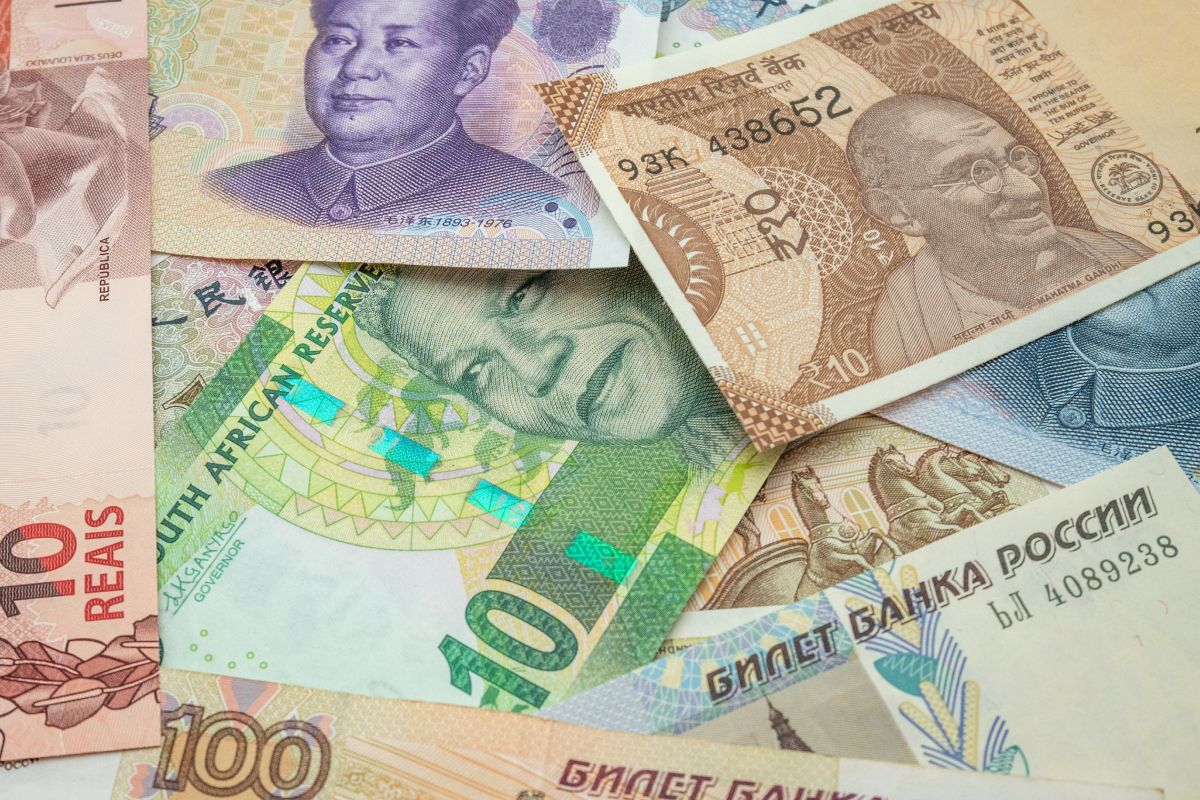
The BRICS group has been plagued by negative news in the past few months, with conspiracy theories related to it constantly emerging. One widely circulated theory is that Russia and China are planning to overthrow the US dollar and push the US economy into an abyss. The recent BRICS meeting did not bring any significant announcements, and the lack of information may continue to fuel conspiracy theories, but it may also reveal another possible outcome.
Is the US dollar falling from its pedestal? It is indeed possible, but not in the way revealed by articles filled with conspiracy theories.
The accession of Argentina, Egypt, Iran, Ethiopia, Saudi Arabia, and the United Arab Emirates to the BRICS group can be seen as a response by the BRICS countries to decades of Western dominance in global governance and finance. The growing desire for alternatives to the US dollar has attracted many countries to adopt diversified international trade and currency reserve methods.
In the coming months or years, commodity trade between countries using alternative currencies may increase, which means a decrease in demand for US dollar reserves, but this does not mean the end of the US dollar as an international legal tender.
As other currencies move towards the center of the stage, cracks begin to appear in the financial pillar of the United States, but this cannot be a reason to expect a comprehensive de dollarization. In fact, due to the diversity of BRICS economies, a unified BRICS currency is not feasible.
The use of gold as a new currency peg, and even the use of blockchain technology, have been mentioned as potential strategies, but are currently seen as longer-term options, which is why these announcements were not made at the BRICS summit in August. On the contrary, other strategies are currently being studied.
One approach is to use more local currencies in trade settlements, including Russia and ChinaTrading in rubles and Chinese yuanIt's just proof. However, this poses challenges in terms of currency convertibility and establishing alternative clearing systems. The trend towards diversification and de dollarization is undeniable, but creating a fair and just currency for all BRICS members is a daunting task.
In addition, some BRICS members are not united in other geopolitical aspects, which may become a source of long-term discord and delay progress. Plus six new members, each bringing their own economic situation and needs.
At present, the goal of BRICS actions is not necessarily to replace the US dollar, but to provide the world with a stable option where no country's currency can have an inappropriate impact on other countries. This is a very good situation.
Why does de dollarization not happen overnight
There is a theory of "de dollarization" that suggests that the BRICS group only needs to return its US dollar reserves to the United States and exchange them for its own currency and gold to trigger the collapse of the US dollar.
The 13 countries with the highest holdings of US dollarsThe foreign exchange reserves have reached an astonishing $12 trillion. Let's calculate that the US Treasury holds approximately261.5 million ounces of goldThe vast majority of them are gold bars. The price of 261500000 troy ounces is 1941 US dollars per ounce, equivalent to 507.6 billion US dollars.
If the BRICS countries suddenly start selling their US dollar reserves, the US treasury will be empty after paying only 10%, and the US will go bankrupt overnight. At the computational level, this approach is valid, but it is naive to believe that such a situation could occur.
The United States is likely not to fulfill its responsibilities according to the agreement. On the contrary, the world is likely to see a press conference similar to the 1971 'Nixon shock', when US President Richard Nixon announced the suspension of the exchange of the US dollar with gold.
If the group takes such aggressive action against the United States, all countries will continue to hold dollars, which can be used or stored, but absolutely not sold.
If the United States fails to fulfill its international obligations, it will not end the dollar. After the brutal announcement in 1971, global financial markets immediately plunged into chaos, but surprisingly, the United States was hardly impacted.
Currency pegged to the US dollar must be revalued or allowed to float freely. With the collapse of the gold standard, most major currencies transitioned to floating exchange rates. This means that the value of currency will be determined by the supply and demand relationship in the foreign exchange market.
In the years following the end of the gold standard, many countries experienced currency inflation and depreciation. During this period, the US dollar itself also faced inflationary pressures, but this did not bring down the United States.
At present, the US dollar remains strong. No country would willingly devalue the billions of dollars in currency it holds. In addition, bankruptcy in the United States is also detrimental to the global economy. A comprehensive and rapid de dollarization is likely to lead to an unprecedented global economic recession.
But this does not mean that de dollarization is just a legend. Russian President Vladimir Putin said that the process of de dollarization is "irreversible" and "the pace is getting faster and faster". Over time, countries can gradually and safely reduce their holdings of US dollars. In fact, this process has already begun. Last year, the share of US dollars held by global central banksDecreased to 59%This is the lowest level in 25 years, compared to 71% the previous year.
It can be speculated that as billions of dollars continue to flow back, the Federal Reserve will be forced to raise interest rates, but fewer and fewer countries will purchase the growing debt. As the currency depreciates, inflation in the United States may continue to rise. Long term high interest rates may erode American industry, and the US stock market may feel pressure.
Ultimately, the Federal Reserve will have to lower interest rates, accept currency depreciation, and begin focusing on rebuilding the US economy under a new model. This is similar to the situation experienced by Greece in 2012.
On the trading chart, the US dollar will experience a long-term slow decline against major currencies, and countries such as China and Japan may take advantage of this opportunity to seize the dominant position of the United States in the technology sector, thereby having a negative impact on the prices of US technology stocks.
So far, the United States has relied on borrowed time and borrowed money to survive, but ultimately will have to face reality. For decades, the United States has touted itself as the 'greatest country in the world', and the cost has been high. Now is the time to repay it.
Of course, this is all speculation, please remember: this is just one version of the future. Either it's war or a new alliance, the United States may take different paths, but each path has a different destination and different financial outcomes.
As a trader, one should have a global perspective, make long-term plans, and grasp short-term fluctuations in the future. If the financial industry accepts the fact of US bankruptcy, investors will abandon the US dollar. The most likely alternative to the US dollar is metals, and may even be digital currencies. This transformation will slow down and then regain momentum. Look for early signs and view every economic report with a critical eye.
useExness explosion protection functionEngage in trading with greater confidence than ever before in the face of market volatility.