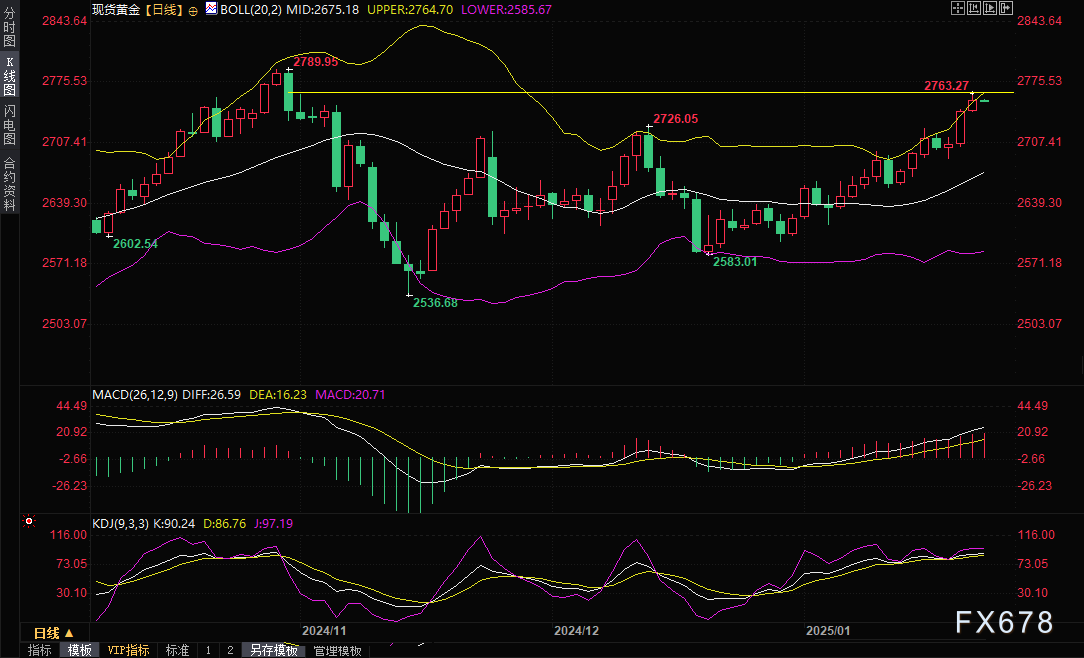
**********On Wednesday (January 23) during the Asian session, spot gold fluctuated narrowly and is currently trading around $2755.59 per ounce. Gold prices surged to a nearly three-month high of $2763.27 per ounce on Wednesday, trading slightly below historical highs, driven by the weakening of the US dollar and unclear policy plans from US President Trump. Investors are concerned that Trump's policies may trigger a trade war and exacerbate market volatility.
The US dollar index fell to a more than three week low at the beginning of Wednesday's trading session, causing the price of gold denominated in US dollars to decrease for holders of other currencies. However, the subsequent rebound of the US dollar made gold bulls hesitant, and the gold price fluctuated and adjusted around 2763.27, closing at 2756.11 US dollars per ounce. In addition, some short-term long positions taking profits also slightly limit the increase. However, if the gold price can close above the high of 2762.13 on November 1st, it is still expected to explore resistance near the historical high of 2790.
Ryan McIntyre, Senior Portfolio Manager at Sprott Asset Management, said, "There is uncertainty about proposed tariffs and other things, and when there is a lot or even moderate uncertainty in the market, gold usually performs well, which is an asset that people naturally tend to lean towards
Trump stated that his administration is discussing imposing a 10% tariff on goods imported from China on February 1st, while on the same day, he had previously stated that Mexico and Canada could face tariffs of around 25%.
Gold is often seen as a safe haven during times of economic and geopolitical turmoil, but Trump's proposed policies are widely seen as stimulating inflation and may force the Federal Reserve to maintain high interest rates for a longer period of time to curb price pressures.
Trump did not provide many details about his proposed tariffs, which has led investors to speculate about the degree of aggressiveness of the measures and the depth of their potential impact.
Brad Bechtel, Global Head of Foreign Exchange at Furui, said, "We should have made some kind of correction, but in fact, we didn't see any major tariff impact on the first day, which somewhat triggered profit taking. The market doesn't have a lot of tariff premiums, and that's what's being stripped out of the market now, but many trends are actually more about expectations for the Federal Reserve and interest rate differentials
The yield of US 10-year treasury bond bonds rose 2.7 basis points to 4.601%. Since hitting a one-year high of 4.809% in mid January, the yield has dropped by over 20 basis points.
In terms of the Russia-Ukraine conflict, Trump said on Wednesday that if Russia did not reach an agreement to end the war in Ukraine, he would add new tariffs to the threat of sanctions against Russia, and added that these tariffs might also apply to "other participating countries".
This trading day, data on changes in initial jobless claims in the United States will be released, and investors need to pay attention; Also, continue to follow Trump's related news updates.
Trump threatens Russia: end Ukraine war, or else wait to be taxed
When Trump posted on Truth Social, he modified his comment made on Tuesday, stating that if Russian President Putin refuses to negotiate an end to the nearly three-year conflict, he may impose sanctions on Russia.
If we don't reach an 'agreement' soon, I have no choice but to impose high tariffs and sanctions on any goods sold by Russia to the United States, as well as on other participating countries, "Trump said.
Trump did not specify in his post which countries he believed were involved in the conflict, nor did he explain how he defined participation.
Dmitry Polyanskiy, the Deputy Representative of Russia to the United Nations, said that Moscow will have to first understand what Trump believes the "agreement" to end the war in Ukraine means.
This is not just a matter of ending the war, "Poliyanski said. Firstly, the root cause of the Ukrainian crisis must be addressed.
Prior to his victory in the November 5th election, Trump had declared dozens of times that he would reach an agreement between Ukraine and Russia on his first day in office. But Trump's aides acknowledge that an agreement to end the war may take months or longer to reach.
In 2014, the United States imported $13.5 billion worth of Russian petroleum products, but after the implementation of sanctions related to the Ukraine conflict, this number has dropped to zero. Some other major import categories from 10 years ago, including semi-finished steel and pig iron, have also dropped to zero.
The United States still imports a large amount of fertilizers for agriculture from Russia - valued at approximately $1.4 billion in 2023- as well as uranium for nuclear power, and palladium and rhodium for automotive catalytic converters, both worth over $1 billion.
Trump said he "wants to do a big favor to Russia and President Putin, whose economy is declining. Let's reconcile now and stop this ridiculous war
The US military will send 1500 more troops to the US Mexico border to help expel illegal immigrants
The White House announced on Wednesday that the US military will deploy 1500 active duty soldiers to the Mexican border, just two days after President Trump signed an executive order to deport immigrants.
Currently, there are approximately 2200 active duty military personnel and thousands of National Guard personnel stationed at the US Mexico border.
This is (Trump's) first day of action... directing the Department of Defense to make homeland security its core mission, "White House spokesperson Karoline Leavitt told reporters.
Another official who declined to be named said that there have been informal discussions regarding the gradual deployment of up to 10000 military personnel. But the official stated that the number of troops deployed depends on several factors, including the impact on military readiness and the requirements of the Ministry of National Security.
The official added that US military aircraft can also be used to expel illegal immigrants, but this matter has not yet been approved.
On his first day in office, Trump declared a national emergency due to illegal immigration, tasked the US military with assisting with border security, implemented a comprehensive ban on asylum, and took measures to restrict citizenship for children born on American soil.
On January 20th, he issued an executive order directing the Pentagon to dispatch the necessary number of troops to gain "complete operational control over the southern border of the United States".
The Coast Guard, responsible for maritime safety and law enforcement, announced on Tuesday that it will "immediately deploy" troops and ships to some areas, including the southeastern border near Florida, to "block and prevent large-scale maritime immigration from Haiti and Cuba.
The Coast Guard stated that another key area is the maritime border between Texas and Mexico in the "Gulf of America".
Trump has stated that he hopes to rename the Gulf of Mexico as the Gulf of America.
French and German leaders meet to discuss unity in responding to Trump's tariff threat
French President Emmanuel Macron and German Chancellor Olaf Scholz sought unity at a meeting in Paris on Wednesday, as Europe strives to respond with one voice to US President Donald Trump's tariff threats.
Trump also threatened to impose high tariffs on Canada, Mexico, and China, stating on Tuesday that Europe's trade surplus with the United States is concerning and that tariffs will be imposed.
Macron and Scholz both insisted in their statements to reporters before having a working lunch at the É lys é e Palace that Europe is strong and Franco German relations are stable, while also anticipating difficulties.
Scholz said, "It's already clear that President Trump will be a challenge
Our position is very clear. Europe is a large economic zone with about 450 million citizens. We are strong. We are united. Europe will not avoid or hide
Macron has long advocated for greater self-reliance in Europe.
He said, "After the new US government takes office, it is more necessary than ever for Europeans and our two countries to play their part in consolidating a united, strong, and sovereign Europe
The leaders of the two countries mentioned that the steel, automotive, and chemical industries are crucial to the European economy and are potential targets for tariffs imposed by the United States.
Some business leaders and analysts have stated that Trump's first term proved that he often publicly threatened to impose tariffs and take other measures as leverage, but ultimately did not implement them.
But there are also concerns that the strong popular mandate and more support from both houses of Congress will make him bolder.
We have entered a new stage of negotiations with the United States, "French government spokesperson Sophie Primas told reporters before the meeting. The relationship with President Trump is transactional. We must be as firm as the United States and demonstrate our strength
The Franco German relationship must heat up very strongly and very quickly, "said a French government source who declined to be named. Without a strong Franco German relationship, Europe will not restart
European Central Bank decision-makers unanimously support continued policy easing, with a near certainty of interest rate cuts next week
European Central Bank decision-makers expressed support for further interest rate cuts on Wednesday, indicating that next week's rate cuts are almost certain and will continue, even if the Federal Reserve remains cautious in its stance.
The European Central Bank has already cut interest rates four times in response to weak growth and falling inflation. It is expected that the ECB will continue to act quickly in 2025. After US President Trump did not announce worrying trade tariffs against the EU, traders even expanded their bets on the ECB's interest rate cuts this week.
European Central Bank President Lagarde, as well as Board members Francois Villeroy de Galhau, Klaas Knot, and Yannis Stournaras, all support further policy easing. Jose Luis Escriva, the management committee, sounds cautious, but he also subtly proposed reasons for further policy relaxation.
The direction is very clear, "Lagarde said during Davos and the interest rate issue. The pace of adjustment we will see depends on data performance, but we currently believe that gradual action will definitely be taken
Lagarde seems to still oppose rushing, saying that there is no risk of the European Central Bank's inflation rate falling below its 2% target, and the ECB also needs to observe the impact of a weak euro.
Villeroy de Gallo, who also serves as the President of the Bank of France, stated that the European Central Bank's 3% deposit rate may rapidly decrease as the bank is confident in returning to its 2% inflation target.
Villeroy de Gallo said at the World Economic Forum in Davos, "It seems reasonable to expect our policy interest rate to be around 2% by the summer of this year." He estimated the neutral interest rate to be around 2%.
Among all the policy makers who spoke, Spanish Central Bank President Escrihuas was the most cautious, believing that the development of the situation was in line with predictions, but the European Central Bank would not promise to take any action in advance. However, these predictions are based on the premise of interest rate cuts this year, indicating that Escobar also agrees to further relax policies.
According to currency market prices, the market almost fully expects the European Central Bank to cut interest rates four times this year, keeping the deposit interest rate of eurozone banks with the central bank at 2%. This is close to the lower limit of the neutral interest rate range considered by economists at the European Central Bank, which is a level of interest rate that neither stimulates nor suppresses the economy.
The interest rate cuts by most central banks around the world have provided strong upward momentum for gold prices in 2024. If the European Central Bank continues to cut interest rates, it is expected to provide further opportunities for gold prices to rise.