**********On Thursday (January 23), US crude oil continued to decline during the Asian trading session, trading around $75.23 per barrel. Analysts from Ritterbusch and Associates, an energy consulting firm, said in a statement on fundamentals that
The possible sanctions measures that the new Trump administration may take are still unclear, and the tariffs that may be imposed on Canada and Mexico now seem to be the number one uncertainty facing traders
Therefore, the uncertainty of market demand expectations and economic growth expectations has led to a continuous decline in oil prices, while concerns about overcapacity on the supply side are also helping to adjust oil prices downward.
According to data from the American Petroleum Institute (API), crude and finished oil inventories in the United States increased last week. According to market research, the average estimated decrease in US crude oil inventories (EIA) for the week ending January 17 is 1.6 million barrels.
Gasoline inventory may increase by 2.3 million barrels, and distillate inventory may increase by 300000 barrels. The expected increase in inventory data is unfavorable for bullish oil prices.
At present, after the significant rebound this round, the fundamentals did not meet expectations, leading to a return to box bound fluctuations in oil prices. However, it should be noted that the faster the short-term decline, the greater the probability of a pullback. This trading day, we will focus on the changes in EIA inventory data to see if they support the stabilization and rebound of oil prices.

Trump stated that his administration is discussing imposing a 10% tariff on goods imported from major Asian countries on February 1st, while he had previously stated that he would impose approximately 25% tariffs on goods imported from Mexico and Canada on the same day.
He also vowed to impose tariffs on European imports, but did not provide more details, and threatened to impose new tariffs on Russia if it did not reach an agreement to end the Russia-Ukraine conflict.
Trump also stated that his administration is "likely" to stop purchasing oil from Venezuela, which is a member of the Organization of the Petroleum Exporting Countries (OPEC) under US sanctions.
Ukrainian Deputy Prime Minister: Ukraine hopes to end the war by 2025
Ukraine's First Deputy Prime Minister and Minister of Economy Yulia Sviridenko stated that Ukrainian authorities expect the war to end by 2025.
Sviridenko expressed his hope that the war would end by 2025 and emphasized that Kiev is considering dialogue with Russian President Putin.
It should be noted that if the easing sentiment of the geopolitical situation continues to rise, it is also one of the important factors that are unfavorable for oil price bulls.
From a technical perspective, although US crude oil has been bullish for four consecutive weeks, it has not chosen to accelerate its breakthrough, and the daily bearish trend has continued to decline, which has undermined the confidence of market bulls.
At present, the MACD indicator is accelerating its downward trend, but the price has not fallen below the support of the central axis of the upward channel, and the deviation of the moving average has narrowed. Pay close attention to whether the support around $75 is effective during the day.
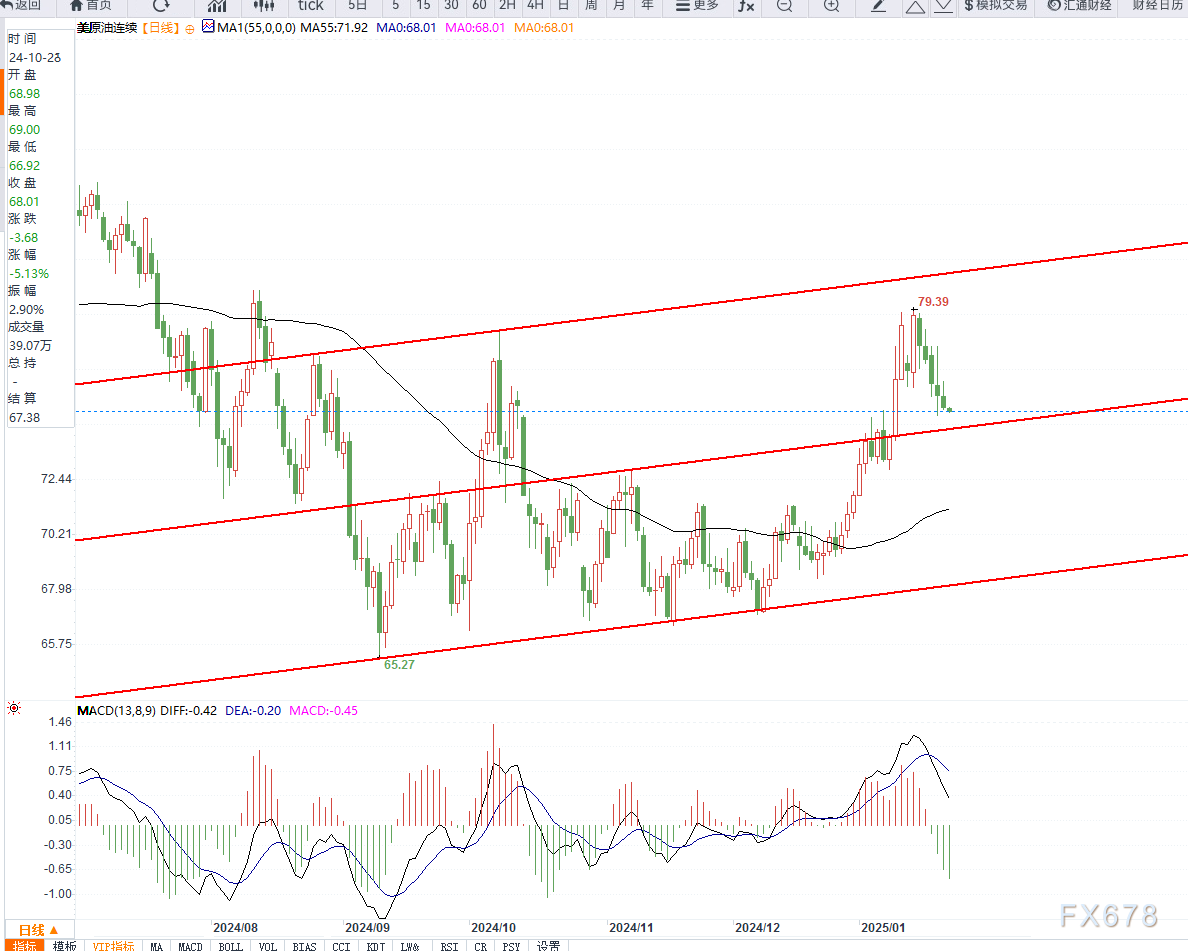
At 10:42 Beijing time, US crude oil is currently reported at $75.27 per barrel.