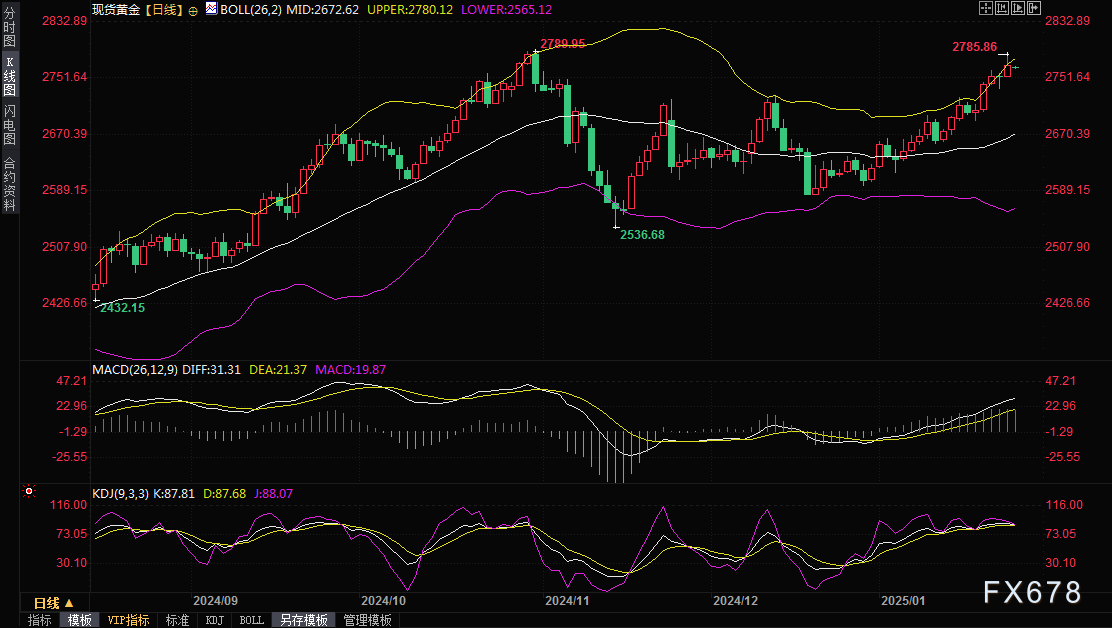
**********On Monday (January 27th) morning trading in the Asian market, spot gold fluctuated slightly lower and is currently trading around $2767.72 per ounce. Gold prices continued to rise 0.6% last Friday (November 24th), reaching a high of $2785.86 per ounce during trading, just one step away from the historical high of $2789.95, closing at $2771.51 per ounce. The weekly increase was 2.5%, marking the fourth consecutive week of gains as uncertainty surrounding US President Trump's trade policies weakened the US dollar and boosted demand for safe haven asset gold.

Bart Melek, head of commodity strategy at TD Securities, said, "One of the factors seems certain to be the decline of the US dollar... Some of the biggest factors driving the decline of the US dollar are related to President Trump's discussion of tariffs
At the World Economic Forum on Thursday, Trump called for an immediate interest rate cut. The US dollar hit a new low in over a month last Friday, which has led to a decrease in the price of gold for foreign buyers.
The US dollar fell 0.63% last Friday, closing at 107.46, with a weekly decline of 1.77%, marking its worst weekly performance in over a year. People expect that the tariffs implemented by US President Trump will be lower than previously feared and are unlikely to trigger an international trade war.
The prospect of imposing high tariffs on goods from China, Canada, Mexico, the euro area and other places has raised concerns about the resurgence of inflation, which has pushed up the yield of US treasury bond bonds and the US dollar in recent months. However, the upward trend has partially reversed, and traders are betting that tariffs may not be as large-scale or widespread as previously feared. Trump stated last Thursday that he believes a trade agreement can be reached with China.
Adam Button, Chief Currency Analyst at ForexLive, said: 'People are becoming increasingly skeptical that tariffs will come.'“
On January 13th, the US dollar index hit its highest level since November 2022 at 110.17. Last week, the US dollar index fell 1.77%, marking the largest weekly decline since November 2023.
The market expects the Federal Reserve to keep interest rates unchanged at the end of its two-day meeting on Wednesday, but investors will be watching for any clues that may lead to a rate cut in March, provided that inflation continues to slow and approaches the 2% target.
Last Friday's data showed that as price pressure rose, US business activity slowed to its lowest level in nine months in January, but US existing home sales rose to a 10 month high in December.
Consumer confidence in the United States weakened in January for the first time in six months, as consumers are concerned about the labor market and the possibility of rising prices if the Trump administration continues to push forward plans to impose tariffs on imported goods.
Marc Chandler, Chief Market Strategist at Bannockburn Global Forex, said that part of the reason for last week's correction in the US dollar may have been technical, as the dollar has risen 10% since the end of September.
Many good news from the United States has been digested, "he said. If the Federal Reserve maintains interest rate stability while the European Central Bank, the Bank of Canada, and the Swedish central bank all cut interest rates, the strength of the US dollar in the coming week may be tested.
The yield of US treasury bond bonds also fell slightly last Friday, and the yield of US 10-year treasury bond fell 0.39% to 4.625% last Friday, because the data of the world's largest economy in terms of consumer confidence and business activities were weaker than expected, supporting the expectation of the Associated Press to cut interest rates at least once in 2025.
S&P Global announced last Friday that the US Composite Purchasing Managers' Index (PMI), which tracks the manufacturing and service industries, fell to 52.4 this month. This is the lowest level since April, lower than the 55.4 in December.
The Purchasing Managers' Index (PMI) for the US manufacturing industry rose from 49.4 in December to 50.1 at the beginning of January, the highest level since June. Economists predict that the manufacturing PMI will rise to 49.7. However, the initial value of the service sector PMI fell from 56.8 last month to 52.8, far below economists' expectations of 56.5.
In another report, the University of Michigan's final estimate of consumer sentiment decreased from 73.2 to 71.1.
According to data from the London Stock Exchange Group (LSEG), after the release of US data, the expectation for interest rate futures to cut interest rates by 2025 has risen from 39 basis points late last Thursday to 42 basis points. The market also believes that there is a 71% chance that the next interest rate cut may take place at the Federal Reserve's June meeting.
Investors are still waiting for the new government to introduce clearer tariff policies.
US President Trump softened his stance on China on tariffs late last Thursday. In an interview with Fox News, Trump stated that he would rather not impose tariffs on China as he believes a trade agreement can be reached with the world's second-largest economy. This is a huge step backwards compared to his campaign threat to impose a 60% tariff on Chinese imports.
Federal Reserve policymakers are expected to remain inactive this week, but the bigger debate will be how the Fed will respond to Trump's previous remarks, including calls for the Fed to continue reducing borrowing costs. The Federal Reserve is scheduled to hold policy meetings on Tuesday and Wednesday.
KITCO survey shows that most analysts and retail investors tend to be bullish in the future.
Ten analysts participated in the Kitco News Gold survey, and the strongest majority in months predicted gold prices in the coming days. Eight experts (or 80%) predict a rise in gold prices in the coming week, while only one analyst (or 10%) predicts a decline in precious metal prices, and gold metal's recent consolidation.
At the same time, 169 votes were cast in Kitco's online poll, and retail investors were also very bullish, although less than experts. 118 retail investors (or 70%) believe that gold prices will rise in the coming week, while another 25 or 15% of retail investors expect gold prices to fall in the coming week. The remaining 26 investors (about 15% of the total) predict that gold will fluctuate in the short term.
In addition to the Federal Reserve's interest rate decision, this week will also include the US December durable goods order monthly rate, the Bank of Canada's interest rate decision, the European Central Bank's interest rate decision, the US fourth quarter GDP data, and the US December PCE data. It can be said to be a super week, and investors need to adjust their positions in advance.
It should be noted that investors also need to closely monitor the dynamic news of US President Trump.
US President Trump announced on Sunday (January 26) that he will implement comprehensive retaliatory measures against Colombia, including tariffs and sanctions. Previously, Colombia refused entry to two US military planes carrying repatriated immigrants.
Colombia quickly responded by threatening to impose a 50% tariff on American products. Colombia is the third largest Latin American trading partner of the United States.
Trump posted on "Truth Society" stating that Colombian President Gustavo Petro's refusal to accept these flights poses a threat to US national security.
The retaliatory measures include imposing a 25% tariff on all Colombian goods entering the United States, which will rise to 50% within a week; Implementing a travel ban and revoking visas for Colombian government officials; And implement emergency fiscal, banking, and financial sanctions.
Trump also stated that he will instruct to strengthen border checks on Colombian nationals and goods.
US Secretary of State Rubio stated in a statement that the United States "will no longer be deceived or exploited" and added that Petro approved these flights and provided all necessary authorizations, but cancelled the authorizations during the flight.
Trump declared illegal immigration a national emergency and implemented a comprehensive crackdown since taking office last Monday.
Petro wrote on X: 'The United States cannot consider Colombian immigrants as criminals.' Mexico also refused last week to land a US military plane to repatriate immigrants.
Trump has not taken similar actions against Mexico, but has stated that he is considering imposing a 25% tariff on products from Canada and Mexico on February 1st to further combat illegal immigration and fentanyl inflows into the United States.