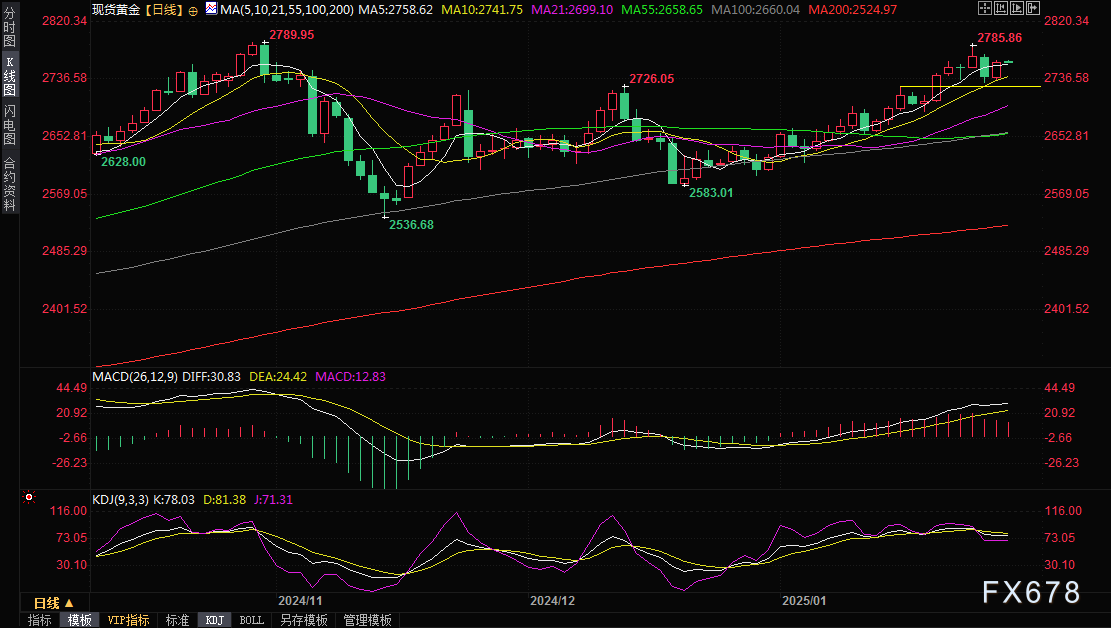
**********On Wednesday (January 29th), in the morning session of the Asian market, spot gold fluctuated narrowly and is currently trading around $2763.26 per ounce. Gold prices rebounded over $20 on Tuesday as investors remained interested in this safe haven asset amid increasing uncertainty over US President Trump's proposed tariffs; In addition, the poor monthly performance of durable goods orders in the United States has also boosted the rebound momentum of gold prices.
Gold prices fell 1% on Monday due to technology stocks leading the overall market sell-off, marking the largest decline since December 18th. On Tuesday, gold prices rebounded 0.8% and closed at $2763.25 per ounce.

Daniel Pavilonis, Senior Market Strategist at RJO Futures, said, "I think the biggest factors are Trump's comments about tariffs yesterday... and now, what's related to gold is a basket of geopolitical situations and inflation expectations
Trump said on Monday that he plans to impose tariffs on imported computer chips, drugs, and steel to encourage manufacturers to produce these products in the United States.
Trump's policies are not only believed to trigger inflation, but also have the potential to trigger a trade war, thereby increasing safe haven demand for gold.
Data shows that in the fourth quarter of the United States, corporate equipment spending may be suppressed after the Boeing strike disrupted aircraft deliveries.
The report from the US Department of Commerce on Tuesday shows that enterprise equipment investment is expected to rebound in the first quarter. President Trump's new administration plans to cut taxes and lower regulatory barriers, which may stimulate spending, but import tariffs may be a barrier.
Although companies intend to increase investment, consumers are becoming increasingly nervous about the labor market and are not as optimistic about the current and future economic prospects, which suggests a slowdown in spending. Another report shows that households also expect inflation and interest rates to rise this year.
LPL Financial Chief Economist Jeffrey Roach said, "Economic growth in the first quarter may be close to trend levels, but if the job market softens faster than expected, economic growth may be below trend levels
The US Bureau of Statistics stated that orders for non defense durable goods, excluding aircraft, increased by 0.5% month on month in December, with an upward revision of 0.9% in November, compared to the previous value of 0.4%. This is a highly regarded indicator for measuring a company's expenditure plan. Economists surveyed by Reuters previously predicted that this core durable goods order would increase by 0.3%.
The core durable goods orders in December increased by 0.6% year-on-year. The shipment volume of core durable goods increased by 0.6%, compared to a 0.4% increase in November.
After a 2.0% decline in November, orders for durable goods such as toasters and airplanes that can be used for three years or longer decreased by 2.2% in December, far below market expectations of a 0.6% growth.
After a 3.2% decline in November, non defense durable goods orders decreased by 7.8% in December. After a 0.9% decrease in November, the shipment volume of this type of product increased by 3.5% in December.
The shipment volume of such goods will be included in the calculation of the equipment expenditure of enterprises in the Gross Domestic Product (GDP) report. The paralyzing strike by Boeing factory workers began in mid September and ended in early November, disrupting aircraft production and delivery.
The US government is scheduled to release the initial GDP value for the fourth quarter on Thursday.
A Reuters survey of economists predicts that the quarter on quarter GDP growth rate is expected to be 2.6%. The economy grew by 3.1% in the third quarter.
At least in the minds of consumers, the excitement of the election seems to be fading. The Consumer Confidence Index of the World Enterprise Research Institute fell from 109.5 in December to 104.1 in January, marking the second consecutive month of decline. Economists previously predicted an increase to 105.6.
The proportion of consumers who believe that job opportunities are "sufficient" has decreased from 37.1% in December to 33%. The proportion of people who believe that jobs are difficult to find has increased from 14.9% to 16.8%. The labor market gap in the survey narrowed from 22.2 in December to 16.2. This indicator is related to the unemployment rate in the monthly employment report of the Ministry of Labor. The unemployment rate in December was 4.1%.
The average annual inflation expectation of consumers has risen from 5.1% in December to a six-month high of 5.3%. Dana Peterson, Chief Economist of World Enterprise Research, pointed out that "in written responses, inflation and prices are still the main things mentioned
More than half of consumers expect interest rates to rise this year. The proportion of consumers planning to purchase a car in the next six months is the lowest in five months, and the proportion planning to purchase a home is also the same. The proportion of consumers with vacation plans has dropped to the lowest level since October last year.
However, potential homebuyers may get some breathing room. According to a report released by the Federal Housing Finance Agency (FHFA), housing prices rose 4.2% year-on-year in November and 4.5% in October, despite an increase in supply.
On Tuesday, the US dollar index also rebounded 0.53% to close at 107.90, which still makes gold bulls hesitant.
Investors are currently focused on the Federal Reserve's interest rate decision scheduled to be announced at 03:00 Beijing time on Thursday, January 30th, as well as the press conference by Federal Reserve Chairman Powell starting at 03:30.
It is widely expected that the Federal Open Market Committee will maintain the benchmark overnight rate in the range of 4.25% -4.50% at the end of its two-day policy meeting. Powell may adopt a cautious tone at the press conference after the meeting and maintain the openness of the Fed's options so that decision-makers have time to assess how President Trump's administration will reshape the fiscal landscape.
Raymond James, Director of Fixed Income Capital Markets, Vinny Bleau, said, "The market may be feeling uneasy about Powell's speech at the press conference. Everyone knows the Fed won't do anything. Now it's more about understanding how many times the Fed is considering cutting interest rates. A few weeks ago, the market thought the Fed would only cut interest rates once, but now we're back to two
According to calculations by the London Stock Exchange Group (LSEG), in the event of a tech stock crash, the US interest rate futures market is expected to cut interest rates by about 49 basis points this year, or two cuts of 25 basis points each, with little change compared to later on Monday.
The European Central Bank will also hold a meeting this Thursday and is expected to cut interest rates by 25 basis points. People generally expect that the Bank of Canada is likely to lower its key indicator interest rate by 25 basis points on Wednesday. The central bank's interest rate cut generally leads to a decrease in the opportunity cost of holding gold, which tends to support the gold price.