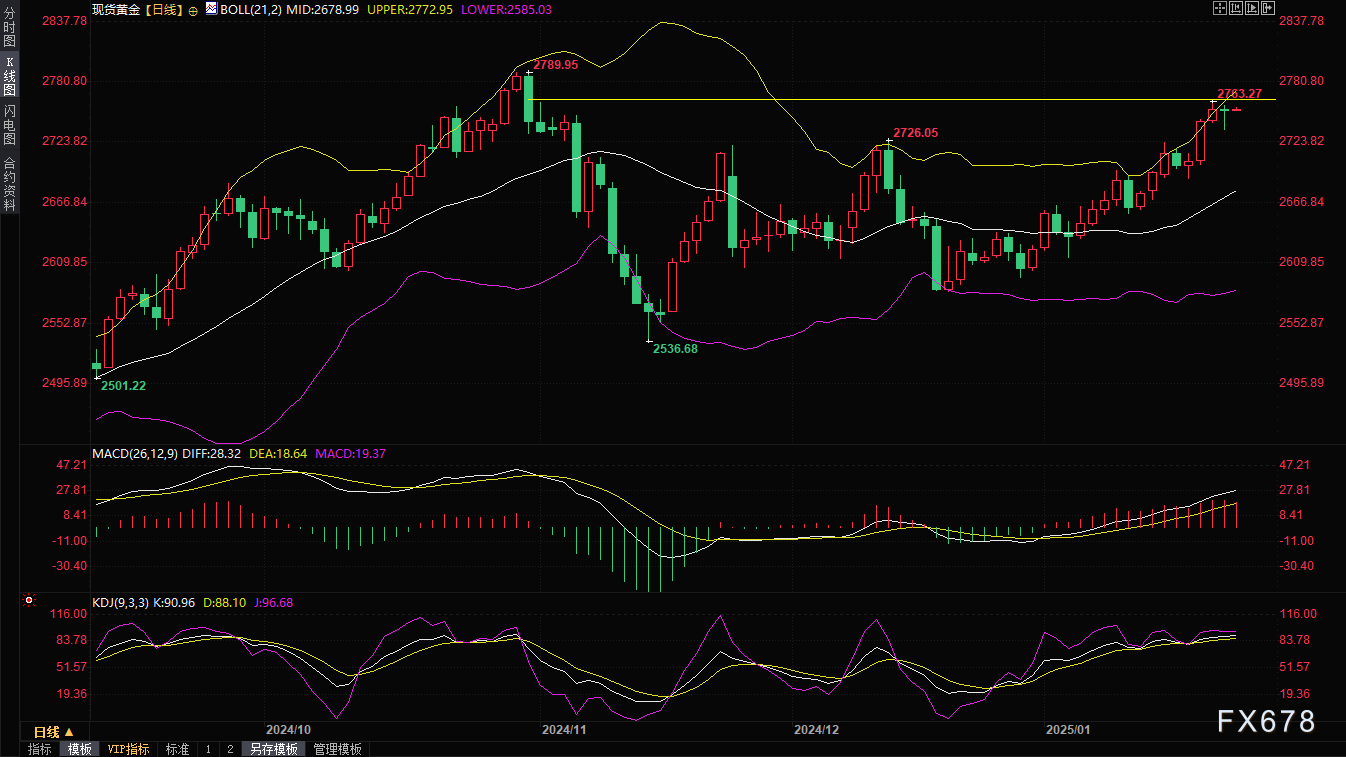
**********On Friday morning (January 24th), spot gold fluctuated narrowly in the Asian market, currently trading around $2754.29 per ounce. Spot gold hit a bottom and rebounded on Thursday, falling to $2735.83 per ounce earlier in the session. However, the performance of the US initial jobless claims was worse than market expectations, and after US President Trump called for lower interest rates, the US dollar weakened, and gold prices recovered all their losses, closing at $2754.59 per ounce. Market attention remains focused on the broad impact of Trump's policies.
Daniel Pavilonis, Senior Market Strategist at RJO Futures, said, "Part of the reason is the US dollar. Earlier on Thursday, the US dollar rose and was then sold off, which pushed gold out of its lows. Thursday's trend only recognized the direction of the White House. I think some of the volatility was due to this expectation
During his speech at the World Economic Forum, Trump emphasized his commitment to reversing inflation and announced his desire for an immediate interest rate cut. He also urged other countries to take similar measures to address global economic challenges.
However, according to the CME FedWatch Tool, traders believe that the likelihood of the Federal Reserve keeping interest rates unchanged at its meeting on January 28-29 is 99.5%.
The uncertainty of Trump's future policies has prompted market participants to flock to safe haven assets such as gold to hedge against volatility. Investors need to pay attention to Trump's dynamic news and changes in market sentiment.
Attention should be paid on this trading dayBank of JapanInterest rate resolutions and January PMI data for European and American countries.
The Bank of Japan is expected to raise interest rates to the highest level since the 2008 financial crisis, hinting at further rate hikes
The Bank of Japan is expected to raise interest rates to the highest level since the 2008 global financial crisis on Friday, as global stock markets rose, easing concerns among policymakers about potential market turbulence caused by US President Trump's tariff threat.
As traders have almost completely digested the possibility of interest rate hikes, market attention has now turned to the post meeting press conference of Bank of Japan Governor Kazuo Ueda, seeking clues about the speed and timing of subsequent interest rate hikes.
The Bank of Japan will end a two-day meeting on Friday, and the market generally expects the bank to raise its short-term policy rate from 0.25% to 0.5%, which will be the highest interest rate in Japan in 17 years. This move will highlight the Bank of Japan's determination to steadily raise interest rates to around 1%. Analysts believe that 1% is the level that will not cause a cooling or overheating of the Japanese economy.
Naomi Muguruma, Chief Bond Strategist at Mitsubishi UFJ Morgan Stanley Securities, said, "The market has not shown too much negative reaction to Trump's remarks, so the Bank of Japan may continue to raise interest rates
The number of initial jobless claims in the United States increased slightly last week
The number of initial jobless claims in the United States only slightly increased last week, indicating that the labor market conditions have not deteriorated and strengthening expectations that the Federal Reserve will not cut interest rates next week.
Although the number of layoffs is still relatively small, new job opportunities for unemployed workers are decreasing due to employers' cautious attitude towards increasing the number of employees. The report released by the US Department of Labor on Thursday showed that the number of unemployed people in early January reached the highest level in over three years.
The labor market is in a historically tense state, but some industries are slowing down their hiring pace, "said Jeffrey Roach, Chief Economist of LPL Financial." The data shows that there is little pressure on the job market. As long as wage growth exceeds the inflation rate, the economy will continue to soar, and the Federal Reserve will not cut interest rates as significantly as expected a few months ago
In the week ending January 18th, the number of initial jobless claims increased by 6000, seasonally adjusted to 223000. Economists previously predicted that the number of applicants in the past week would be 220000. The wildfires in Los Angeles have led to an increase in the number of applicants, while the unadjusted number of applicants in California has increased, but the number of applicants in most states has decreased.
The low temperatures in most parts of the United States and blizzards in the south may temporarily increase the number of applicants in the coming weeks. However, despite this, the labor market may continue to maintain strong momentum, and economic expansion is still on track.
Last week, the number of unadjusted applicants decreased significantly by 68135 to 284222. As of the week ending January 11th, the number of people receiving unemployment benefits increased by 46000 seasonally adjusted to 1.899 million, the highest level since mid November 2021.
The Federal Reserve is expected to remain inactive next week
The strong labor market was one of the factors that prompted the Federal Reserve to reduce its expected number of interest rate cuts for this year from four when it began its easing policy cycle in September to two last month.
President Trump's new administration's plans to crack down on immigration, reduce taxes, and impose widespread tariffs have also increased the cautious attitude of Federal Reserve officials towards the direction of monetary policy. Economists say that the above measures will stimulate inflation, while large-scale expulsion of illegal immigrants and restrictions on legal immigration may hinder the labor market.
The Federal Reserve policy meeting next week is not expected to cut interest rates. Since September, the Federal Reserve has lowered its benchmark overnight rate by 100 basis points, with the current rate range being 4.25% -4.50%. The policy interest rates for 2022 and 2023 have been raised by 5.25 percentage points.
After the Federal Reserve actively tightened its policies between 2022 and 2023, the pace of recruitment has slowed down.
The Federal Reserve meeting is approaching, and Trump is pressuring for an immediate interest rate cut
US President Trump stated on Thursday that he will demand an immediate interest rate cut and other countries should follow suit, marking his first strong attack on the Federal Reserve's monetary policy since taking office on Monday.
Trump said at the World Economic Forum held in Davos, Switzerland on Thursday, "As oil prices fall, I will demand an immediate interest rate cut, and similarly, global interest rates should all fall." Trump later stated at the White House that he hopes the Federal Reserve will listen to his opinions on interest rate issues and he will consider discussing this matter with Federal Reserve Chairman Powell.
Five days later, the Federal Reserve will hold its first policy meeting of Trump's current term on January 28th and 29th, and it is widely expected that interest rates will remain unchanged. Several Federal Reserve officials, including Powell, have stated that due to the stickiness of inflation, caution is needed in further lowering interest rates. Several policy makers made efforts to take into account Trump's potential policies in the new forecast released at the December meeting.
New York Fed President Williams stated last week that the uncertainty surrounding government policy actions makes it difficult to provide guidance on the prospects of monetary policy at present.
The economic outlook remains highly uncertain, especially in terms of potential fiscal, trade, immigration, and regulatory policies, "Williams said. Therefore, our decisions on future monetary policy actions will continue to be based on overall data, the evolution of the economic outlook, and the risk of achieving dual mission goals
Many economists and investors believe that Trump's plans to impose massive tariffs on US trading partners (essentially tariffs on imported products) and expel a large number of illegal immigrants pose a real risk of reigniting inflationary pressures. The next question is whether Federal Reserve officials consider price increases to be a one-time event or the beginning of a more sustained uptrend that may require interest rate hikes to respond.
Some Federal Reserve officials believe that the inflation situation may soon be clear enough for the Fed to restart interest rate cuts. On January 16th, Federal Reserve Governor Waller mentioned recent favorable price pressure data, "If we continue to see such data, we have reason to believe that interest rate cuts may occur in the first half of this year
Waller was elected as a member of the Federal Reserve Board by Trump in 2020, and he is also skeptical about whether Trump's envisioned trade tariffs will push up inflation as many economists believe. He said on January 8th, 'If tariffs do not have a significant or sustained impact on inflation as I expected, then they are unlikely to affect my view on appropriate monetary policy.'
Trump strongly calls for lowering interest rates and oil prices at the Davos Forum
In his speech to global business and political leaders, US President Trump called on the Organization of the Petroleum Exporting Countries (OPEC) to lower oil prices, demanded that countries around the world lower interest rates, and warned them that if products are produced anywhere outside the United States, they will face tariffs.
I will demand an immediate reduction in interest rates. Similarly, interest rates around the world should be lowered, "Trump said via video at the World Economic Forum in Davos, Switzerland on Thursday. I will also demand that Saudi Arabia and OPEC lower oil prices
This is Trump's first speech to global leaders since taking office as president four days ago. This statement reinforces a message that his second term will abandon free market norms both inside and outside the United States. Despite his tough rhetoric on the tariffs he hopes to implement, Trump did not provide specific details while the market was preparing for his plan.
Trump delivered a speech to approximately 3000 Davos attendees, who cheered as his face appeared on the big screen. He listed a series of adjustments he has made since taking office on Monday, overturning the US government's policies on diversity, climate change, and immigration.
In subsequent conversations with attendees such as Bank of America CEO Monihan and Blackstone Group CEO Susmin, Trump sometimes praised and sometimes criticized.
Trump once accused Monihan and JPMorgan Chase of not providing banking services to conservatives, but did not provide any evidence or details of any misconduct. The relevant banks quickly issued a statement stating that these accusations were untrue.
Trump has left some of his harshest criticism to Canada and the European Union, traditional allies of the United States. He has once again threatened to impose new tariffs on both, while condemning their trade surplus with the United States. He said, 'One thing we will demand is respect from other countries. Canada. We have a huge deficit with Canada. We will not do it again.' Some Davos attendees subsequently praised his straightforward style, while others gently countered his statement.
It's not particularly surprising that you want to promote the growth of your own country, "Norwegian Foreign Minister Espen Barth Eide said after Trump's speech. Of course, we believe that in a world of free trade, we will live better as we can openly exchange goods and services
Trump also stated that he is seeking talks with Russian President Putin regarding the war in Ukraine.
Trump warns global businesses to either produce in the United States or face tariffs
US President Trump told global business leaders on Thursday that they should produce products in the United States to avoid import tariffs and enjoy low tax rates.
Trump delivered a speech via video from Washington to the World Economic Forum in Davos, Switzerland, warning that the United States will impose "different amounts" of new tariffs on all countries.
My message to all businesses around the world is very simple: come to the United States to produce your products, and we will be one of the lowest taxed countries on Earth, "Trump said to a corporate executive panel forum.
But if you don't produce products in the United States, which is your privilege, then it's simple, you'll have to pay tariffs, "Trump said. The amount may vary, but tariffs will guide billions or even trillions of dollars into our treasury to strengthen our economy and repay our debts
Trump proposes to impose a 15% corporate tax on companies produced in the United States, subject to congressional approval.
Trump did not provide any new clues on the next specific measures for his government to implement tariffs.
All of his senior economic cabinet nominees are still awaiting confirmation from the US Senate, including Treasury Secretary nominee Besson, Commerce Secretary nominee Lutnik, and US Trade Representative nominee Greer.
Senate Majority Leader Thune told reporters that the Senate may vote on Benson's nomination over the weekend. Lutnik will attend the Senate confirmation hearing next Wednesday, but Greer's hearing has not been scheduled yet.
After Trump's remarks, the US dollar fell
The US dollar fell slightly in volatile trading on Thursday, following President Trump's call for lower interest rates but no clear statement on tariffs. Investors are waiting for a new round of policy announcements from global central banks.
The US dollar fell more than 1% this week, mainly due to a significant drop on Monday as the widely expected tariff measures announced by Trump after his inauguration failed to materialize. The US dollar exchange rate plummeted 1.2% on Monday, marking the largest daily drop since November 2023. In the following trading days, the US dollar only fluctuated slightly. On Thursday, the US dollar index fell 0.1% to close at 108.14.
Sonora Wealth Group's investment advisor David Eng said, 'We don't have any truly certain information, so until we get a clear answer, we will continue to see more volatility. The market seems more focused on interest rate cuts and whether there will be further signs of them.'.
Investors are waiting for global central banks to make a series of policy decisions next week. It is widely expected that the Bank of Japan will raise interest rates at the end of its two-day meeting on Friday.
The Federal Reserve and the European Central Bank will make interest rate decisions next Wednesday and Thursday, respectively.
The market believes that the possibility of the European Central Bank cutting interest rates at the meeting is close to 96%, and recent statements from the central bank's decision-makers indicate that a rate cut may be possible.