**********On Thursday (January 30th), US crude oil rose slightly during the Asian trading session, trading around $72.80. Fundamentally, according to data from the US Energy Information Administration (EIA), refinery purchases have declined for the third consecutive week.
Last week, the US crude oil inventory increased by 3.46 million barrels, recording the largest increase since last year, causing oil prices to rise and fall to the lowest level of the year.
Meanwhile, the White House reiterated on Tuesday that President Trump plans to impose a 25% tariff on goods imported from Canada and Mexico starting from February 1st.

UBS analyst Giovanni Staunovo wrote in a letter to clients on Wednesday that as investors digest the threat of tariffs, sanctions on Russian energy flows, and concerns about economic growth in major consumer countries, the oil trading market will continue to fluctuate in the near future.
The Federal Reserve Board of the United States maintained interest rate stability on Wednesday, and the Fed has hardly disclosed when it plans to reduce borrowing costsPowellThe table points out that it is too early to judge the impact of Trump's policies.
And emphasizing that the Fed's 2% inflation target will remain unchanged, Powell said at the press conference that "we don't need to rush to adjust our policy stance" and that monetary policy is already "in a good position" to address the challenges at hand.
He pointed out that cutting interest rates too aggressively carries risks, saying, "We know that reducing policy restrictions too quickly or too much may hinder progress in inflation
After the failure of interest rate cuts, the market's demand expectations further slowed down, putting pressure on oil prices before economic stimulus expectations, and increasing policy uncertainty.
Trump has made it clear that if interest rate cuts cannot be achieved through the Federal Reserve, he will adopt economic policies to achieve his goals.
In a video speech at last week's World Economic Forum in Davos, he stated that he would "demand an immediate interest rate cut" and claimed that his understanding of interest rate issues far exceeds that of Federal Reserve officials.
RSM Chief Economist Joe Brusuelas stated in a research report that "the Federal Reserve's decisions this year will be influenced by the Trump administration's trade and immigration policies.
These policies may push up inflation, or more importantly, raise inflation expectations, thereby threatening the Fed's long-term 2% inflation target
The progress towards the 2% inflation target has stalled, and the Federal Reserve is well aware of this, "said Greg McBride, Chief Financial Analyst at Bankrate
He believes that the Federal Reserve did not imply a rate cut at the March meeting after this meeting, and whether to cut rates in the future will depend on a series of strong inflation data.
Jeff Currie, Chief Strategy Officer of Energy Pathways at Carlyle Group, stated in an interview that oil price differentials indicate a "very tight" market supply due to low inventory.
The daily oil production from Iran and Russia has decreased by 1 million to 1.5 million barrels, although the 'reorientation' has mitigated this impact.
Currie said, 'OPEC+has enough room to increase supply in April.' The oil market will experience a non seasonal supply gap in the second quarter.
It also stated that it is "difficult" for US oil production to increase. Despite strong fundamentals, there is still a 'huge obstacle' that needs to be cleared before financial investors return to the oil market.
On a technical level, the MACD indicator has been continuously declining and accelerating again. Before stabilizing in the short term, there may be further adjustments. After the daily trend continues to decline, the downward momentum will slow down, waiting for confirmation of support from the 55 day moving average.
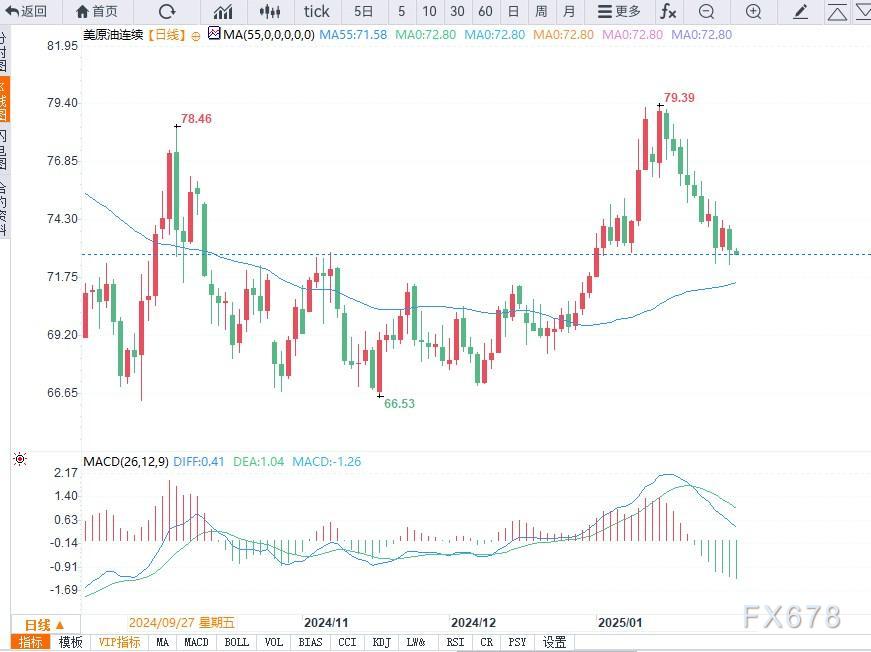
At 09:16 Beijing time, US crude oil is currently reported at $72.78 per barrel.