**********On Tuesday (February 4th Beijing time), spot gold traded around 2814.18, with gold prices hitting a historic high on Monday. US President Trump announced tariffs, intensifying market concerns about inflation affecting economic growth; US crude oil fell more than 1%, trading around $72.38 per barrel. The OPEC+Joint Ministerial Monitoring Committee (JMMC) meeting on Monday discussed US President Trump's call to increase oil production.

The Dow Jones Industrial Average closed down 0.28% on Monday at 44421.91 points; The S&P 500 index fell 0.76% to 5994.57 points; The Nasdaq index fell 1.2% to 19391.96 points.
Key focus for the day: Revised monthly rate of durable goods orders in December in the United States, JOLTs job vacancies in December, monthly rate of factory orders in December, Israeli Prime Minister Netanyahu's meeting with US President Trump at the White House.
stock market
The main stock indexes of the US stock market closed lower on Monday, but the decline narrowed compared to earlier, as US President Trump temporarily suspended tariffs on Mexico after ordering tariffs on three countries, leading to a global influx of safe haven assets.
Trump said that the new tariffs on Mexico will be suspended for one month after Mexico agreed to send 10000 police guards to strengthen its northern border to prevent the flow of illegal drugs.
Carol Schleif, Chief Investment Officer of the Montreal Bank Family Office, said, "Trump is very serious about tariffs becoming his main tool for achieving a range of different goals. They are persistent and the road ahead may be bumpy in the short term. It is clear that the European Union is also his goal
Citigroup analysts pointed out that "if tariffs continue, the market may further decline and there may be inflationary pressures
Five out of the 11 major S&P 500 sectors rose, with defensive sectors such as healthcare and essential consumer goods leading the gains, while the information technology and non essential consumer goods sectors experienced the largest decline. Traditional car manufacturers have regained some lost ground, with Ford falling 1.9% and General Motors falling 3.2%. The Cboe volatility index, known as the Wall Street panic gauge, hit a one week high before falling back to 18.6.
The Russell 2000 Small Cap Index, which is sensitive to the economy, rebounded from a three week low and closed down 1.3%. As investors shift towards safer assets such as bonds and gold, US bond yields have slightly decreased.
Several large companies will release their quarterly financial reports this week. Tyson Foods' stock price rose 2.2% as the company raised its annual sales forecast; IDEXX Laboratories' stock price surged 11.1% as the company's fourth quarter profit and revenue exceeded expectations. In terms of data, according to the Institute for Supply Management (ISM), the US manufacturing industry experienced its first growth in over two years in January.
King City
Gold prices hit a historic high on Monday, as US President Trump announced tariffs, exacerbating market concerns that inflation will affect economic growth. Spot gold rose 0.8% to $2818.99 per ounce, hitting a historic high of $2830.49 at the beginning of trading. US futures closed up 0.8%, with a settlement price of $2857.10.
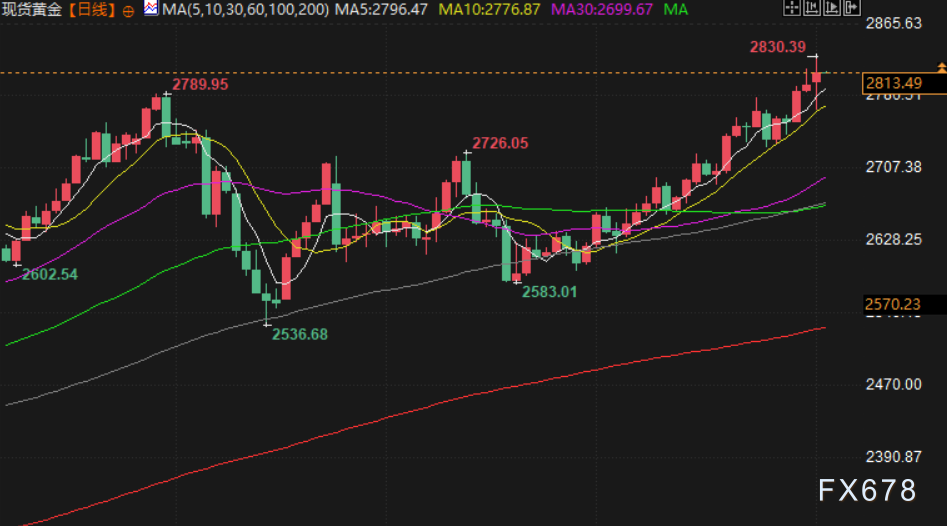
David Meger, head of metal trading at High Ridge Futures, said that although a stronger US dollar usually has a restraining effect on the gold market, gold prices have been rising due to the uncertainty of Trump's tariffs driving safe haven demand.
Canada and Mexico have announced retaliatory measures against US tariff policies, but Trump has announced that tariffs on Mexico will be suspended for one month. At the same time, JPMorgan Chase pointed out that the spread of bear markets in the stock market may drag down gold in the short term, but destructive tariffs continue to fuel the medium-term bull market for gold.
Spot silver rose 0.8% to $31.56 per ounce; Platinum fell 1.5% to $963.40; Palladium rose 0.5% to $1012.85.
Oil market
Oil prices rose in volatile trading on Monday, but the benchmark Brent crude futures still closed at a one month low as the higher priced March futures expired last Friday, digesting news of US President Trump's plan to impose tariffs on Canada and Mexico.

Concerns over imported crude oil from the two major oil suppliers to the United States boosted oil prices, which rose by over $1 per barrel earlier in the session. Following this, Trump announced that he would suspend new tariffs on Mexico for a month as Mexico agreed to strengthen its northern border
To prevent the flow of illegal drugs, especially fentanyl, at the border.
Brent crude oil futures for delivery in April rose 29 cents, or 0.4%, compared to last Friday's closing price, closing at $75.96 per barrel; West Texas Intermediate crude oil rose 63 cents, or 0.9%, to close at $73.16. This is the lowest closing price of Brent crude oil in recent months since January 2nd, as the lower priced April contract became a near month contract after the higher priced March futures expired on Friday.
Trump imposed comprehensive tariffs on Mexico and Canada on Tuesday, affecting global economic growth and reigniting inflation. The proposed tariffs include a 25% tariff on most goods from Mexico and Canada, and a 10% tariff on energy imported from Canada.
Amarpreet Singh, an analyst at Barclays Bank, said in a report that imposing tariffs on Canadian energy imports could be more disruptive to the domestic energy market than imposing tariffs on Mexican energy imports, and could even have a counterproductive effect on one of the president's main goals - reducing energy costs. "
According to data from the US Department of Energy, Canada and Mexico together account for about a quarter of the oil supply processed by US refineries into fuels such as gasoline and heating oil. The US manufacturing industry achieved its first growth in over two years in January, but the recovery may be short-lived due to Trump's tariff policies, which could further increase raw material prices and block supply chains.
Boston Fed President Susan Collins said on Monday that the types of tariffs announced by the Trump administration could push up inflation, while pointing out that there is currently a lot of uncertainty and the Fed does not have the urgency to change the direction of monetary policy. US gasoline futures climbed about 3% to a two-week high.
OPEC+agreed on Monday to adhere to the policy of gradually increasing oil production starting from April and to remove the US Government Energy Information Administration (EIA) from its sources of information used to monitor production and compliance with supply agreements. OPEC+is an alliance of oil producing countries formed by the Organization of the Petroleum Exporting Countries (OPEC) and allies such as Russia.
Russian Deputy Prime Minister Novak announced on Monday that the OPEC+Joint Ministerial Monitoring Committee (JMMC) meeting of the major oil producing countries discussed US President Trump's call to increase oil production.
currencies
The US dollar index fell on Monday after US President Trump announced that the US would temporarily suspend new tariffs on Mexico for one month after Mexico agreed to send 10000 National Guard members to strengthen its northern border to prevent the flow of illegal drugs. Trump said that Mexico and the United States will use this one month suspension period for further negotiations.
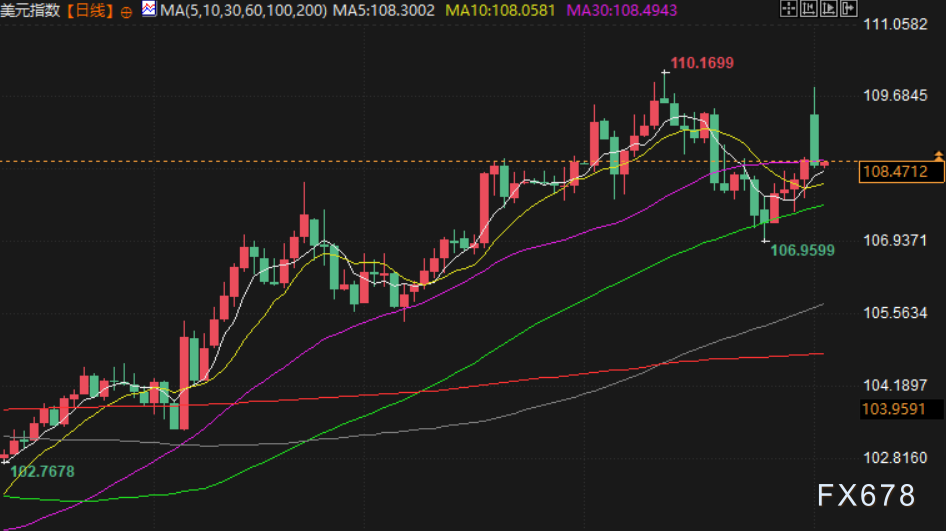
This delay boosted the Mexican peso, which rose 1.25% to 20.4196 against the US dollar in late trading. Earlier, the peso fell to its lowest point of 21.2882 against the US dollar in nearly three years. At the same time, the US dollar index fell 0.5% to 108.96. In the morning session, it reached a three week high of 109.88.
Marc Chandler, Chief Market Strategist at Bannockburn Global Forex, said: 'This delay in Mexico demonstrates that tariffs are just a trading tool.'.
A senior Canadian official told The New York Times reporter that Ottawa is not optimistic about a similar suspension. The Canadian dollar rose to 1.4568 Canadian dollars per US dollar, having previously fallen to a new high since 2003. Economists say that the Republican president's plan will also slow down global economic growth and push up US prices.
Mark McCormick, Head of Foreign Exchange and Emerging Markets Strategy at TD Securities, said, "This move by the US seems to be rebuilding its hegemonic position and forcing the world to pay for its public goods, which is not a routine government operation
After the tariff news was announced, the market lowered its expectations for the Federal Reserve to cut interest rates, and futures prices showed that the likelihood of two rate cuts this year was only 50%.
Some analysts say that once tariffs are implemented, the economies of Canada and Mexico will face the risk of recession, and if tariffs are implemented, the eurozone economy will face further stagnation. Trump said last weekend that tariffs would be imposed on the European Union, but did not specify a specific time.
EU leaders said at an informal summit in Brussels on Monday that if the United States imposes tariffs, Europe will be prepared to retaliate, but also called for rationality and negotiation.
Due to investors' concerns about the Trump administration imposing tariffs on Europe, the euro fell as much as 2.3% to $1.0125, the lowest point since November 2022. The euro fell 0.73% to $1.0286 in late trading against the US dollar.
The Australian dollar hit a five-year low on Monday, while the New Zealand dollar fell to its lowest point since October 2022. These two currencies are often seen as indicators of the flow of the Chinese yuan. On the contrary, the Japanese yen remained strong, with the US dollar falling 0.24% against the yen to 154.845.
international news
US delays plans to impose tariffs on Canada and Mexico
On February 3rd local time, Canadian Prime Minister Trudeau announced that US President Trump has decided to temporarily suspend tariffs on Canadian products for at least 30 days. Canada has also abandoned the implementation of retaliatory tariffs. Earlier on February 3rd local time, Trump had a phone call with Mexican President Simbaum. After the call, both announced that the United States and Mexico had agreed to immediately suspend the implementation of the tariff measures for one month and continue negotiations.
WHO freezes personnel recruitment to cut costs
The World Health Organization Executive Committee meeting will be held in Geneva from March 3rd to 11th this month, discussing issues such as WHO reform, funding, and the 2026 and 2027 WHO budgets. The World Health Organization stated that due to the announcement of the United States' withdrawal from the organization, the shortage of funds has become even more severe. The organization has taken a series of immediate measures, including freezing personnel recruitment in areas other than the most critical. It is reported that these measures include strategic adjustments to resources and activities; Freeze personnel recruitment except for the most critical areas; Significantly reduce travel expenses; Re negotiate major procurement contracts, reduce capital investment, etc. More measures will be announced in due course.
The US State Department has reviewed the International Development Agency, which has been closed
On February 3rd local time, the US State Department stated in a statement that US Secretary of State Rubio told Congress that he is reviewing the foreign aid activities of the US Agency for International Development. The statement stated that the review will 'focus on possible restructuring' to ensure it aligns with the 'US priority agenda'. On that day, the Trump administration shut down the United States Agency for International Development and prohibited its staff from entering its headquarters located in downtown Washington, D.C.
Von der Leyen: The EU will respond firmly when being unfairly treated
On the evening of February 3 local time, President Costa of the European Council, President von der Leyen of the European Commission and Prime Minister Tusk of Poland held a press conference for the informal meeting of EU leaders. Von der Leyen said, "Europe needs to strengthen national defense. Over the years, we have not invested enough in national defense. We need to catch up and strengthen our national defense industrial base.". When talking about the relationship with the United States, von der Leyen said that tariffs would directly damage production and employment. When subjected to unfair treatment or arbitrary attacks, the EU will respond resolutely.
Affected by Trump's tariffs, US gasoline prices may rise by 15 cents per gallon
The United States is preparing to impose a 10% tariff on imported oil and refined oil products from Canada, which could disrupt the US refining and fuel markets that are accustomed to importing about 4 million barrels of crude oil from Canada every day. Mexico has also been threatened by US trade restrictions, despite Trump allowing a one month delay in imposing tariffs on Mexico on Monday. If a 10% tariff is passed on to consumers, it will increase gasoline and diesel prices by about 15 cents per gallon, "said Andy Lipow, an analyst at Lipow Oil Associates." The extent to which consumers are affected depends on their location
The US Treasury Department has lowered its first quarter borrowing estimate to $815 billion
The US Treasury Department has lowered its expectations for federal borrowing for the current quarter and reiterated its previous forecast for cash balances as of the end of March, assuming that Congress will take action to raise or suspend the debt ceiling. The Ministry of Finance stated in a statement on Monday that it now expects net borrowing from January to March to be $815 billion, slightly lower than the $823 billion estimated in October last year. The Ministry of Finance stated that the main reason for the downward adjustment is that the cash at the beginning of the quarter exceeded previous expectations. These estimates are part of the so-called quarterly refinancing plan of the US debt management team headed by the new US Treasury Secretary Scott Besant.
Trump signs executive order to establish sovereign wealth fund within 12 months
US President Trump has signed an executive order stating that he will order officials to establish a sovereign wealth fund for the United States, which was also an idea he proposed during his campaign. We have enormous potential, "Trump told reporters in the Oval Office on Monday, as the initiative will be led jointly by Treasury Secretary Scott Bessent and Commerce Secretary nominee Howard Lutnick. Bessent stated that the creation of sovereign funds within the next 12 months is a matter of significant strategic importance.
The French government's social security budget bill has been passed
On the afternoon of February 3rd local time, French Prime Minister Beru announced in the National Assembly (lower house of parliament) that he would once again use Article 49 (3) of the Constitution to directly pass the French government's social security budget bill without a parliamentary vote. Earlier that day, Beru announced the use of Article 49 (3) of the Constitution to directly pass the 2025 government budget bill without a vote in the National Assembly. (CCTV)
Federal Reserve Collins: There is currently no urgency to cut interest rates again, and there is no urgent need to adjust interest rates
Collins from the Federal Reserve stated that there is still a lot of uncertainty regarding how Trump's policies will be implemented. It can be expected that the widespread US tariffs will affect the prices of the US itself. Universal tariffs will increase prices at all levels of production, while large-scale tariffs will also have a second round of impact. And it stated that there is currently no urgency to cut interest rates again, and the Federal Reserve should remain patient and cautious in its policies, without the need to rush to adjust interest rates. At some point in the future, it is expected to see further normalization of interest rates. The basic trend of inflation has weakened, and more measures need to be taken to reduce inflation.
Domestic news
According to Maoyan Professional Edition data, as of 0:00 on February 4th, the total number of viewers (including pre-sales) during the 2025 Spring Festival has exceeded 168 million, surpassing the total number of viewers during the 2024 Spring Festival and setting a new record for the number of viewers during the Spring Festival in Chinese film history!