**********On Tuesday (February 4th), spot gold traded at $2814.04 per ounce, showing a sideways consolidation trend during the day. Although there has been no significant fluctuation in prices, the gold market remains near historical highs, demonstrating strong performanceHedge demandRecently, the price of gold has repeatedly hit new highs driven by multiple factors, and market sentiment is complex and volatile. Investors need to closely monitor changes in fundamentals and technology.

Safe haven demand supports high gold prices
Recently, the strong performance of gold prices is mainly due to the rising risk aversion sentiment. US President Trump's tariff remarks have once again sparked market concerns, and although some tariffs have been postponed, uncertainty still exists. Drive investors to turn to safe haven assets such as gold.
Renowned institutional analysts pointed out that although the strengthening of the US dollar has exerted some pressure on gold prices, the uncertainty of trade policies still provides support for gold. At present, market expectations for broader tariff measures are heating up, which may further exacerbate market volatility and drive up gold prices. In addition, global gold ETF holdings have increased by over 590000 ounces this year, reaching 83.4 million ounces, indicating a strong demand for safe haven assets among investors.
Key data and events impact market sentiment
This week, the market will receive a series of important US economic data, including job vacancies, ADP employment report, and non farm payroll data. These data will provide the market with more clues about the health of the US economy and may affect the Federal Reserve's monetary policy expectations. At present, the CME FedWatch tool shows that the market expects the probability of the Federal Reserve keeping interest rates unchanged at the March 19th meeting to be 86.5%, while the probability of a 25 basis point rate cut is 13.5%. This expectation has provided some support for the price of gold, as a low interest rate environment typically favors the performance of non yield assets such as gold.
In addition, the speeches of Federal Reserve officials are also worth paying attention to. Atlanta Fed President Bostic and San Francisco Fed President Daley will deliver speeches on Tuesday, and the market will look for clues about the direction of monetary policy from them. If Federal Reserve officials release more dovish signals, it may further boost gold prices.
Technical aspect: Key support and resistance level analysis
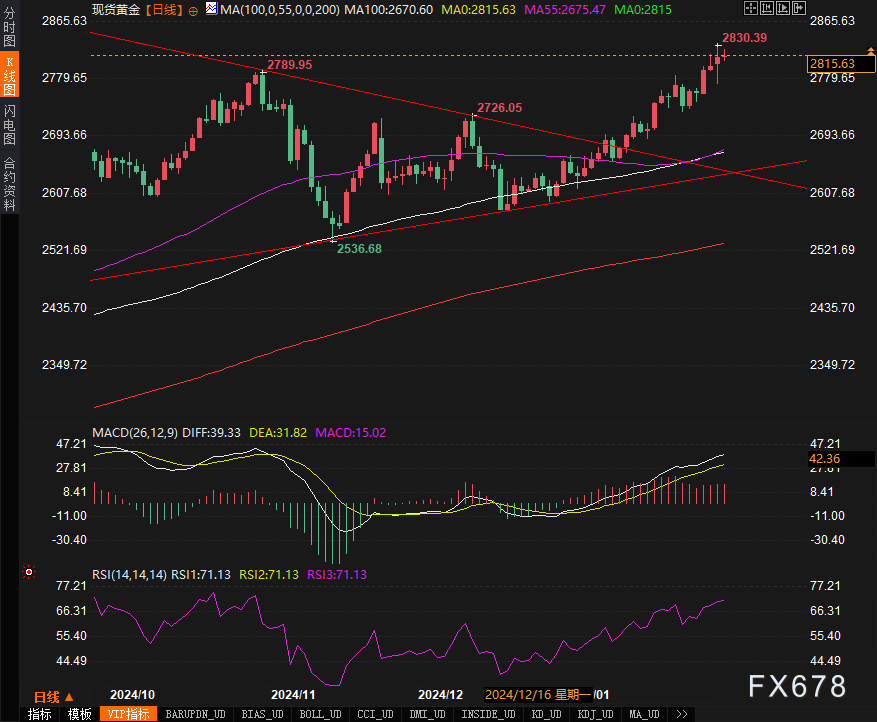
From a technical perspective, the price of gold has recently shown a pattern of high volatility. On Monday, spot gold prices briefly hit a historic high of $2830.70, but then fell back, indicating market divergence near historic highs. At present, the price of gold is supported around $2800, which is not only an important psychological barrier, but also a key area for short-term long short competition.
Analysts point out that the next key resistance levels for gold prices are at $2839 and $2864, which may become short-term upward targets. If the price can break through these resistance levels, it may further explore the psychological barrier of $2900 or even $3000. However, if the price falls below the support level of $2800, it may trigger a short-term correction, with the next support levels at $2790 and $2772.
Future outlook: Can gold continue its upward trend?
Looking ahead, the trend of gold prices will depend on the combined effects of multiple factors. Firstly, the uncertainty of trade policies remains a focal point of market attention. If the tariff issue escalates further, it may continue to drive safe haven demand, thereby supporting gold prices. Secondly, the performance of US economic data will affect the market's expectations of the Federal Reserve's monetary policy, which in turn will have a significant impact on gold prices.
From a technical perspective, the performance of gold prices near historical highs will determine their short-term direction. If the price can stabilize at $2800 and break through the key resistance level, it may initiate a new round of upward trend. However, if market sentiment changes and leads to a decrease in safe haven demand, gold prices may face some downward pressure.
Overall, the gold market is currently in a high volatility phase, and investors need to closely monitor changes in fundamentals and technology to seize future trading opportunities. In the current complex and volatile market environment, the position of gold as a safe haven asset remains stable, but its short-term trend still needs to be treated with caution.