stock market
The three major stock indexes in the United States all closed higher on Wednesday, rebounding from earlier declines as investors shook off the disappointing Alphabet earnings report and weighed the prospect of future interest rate cuts by the Federal Reserve.
Google's parent company Alphabet fell 7.3%, as the company's cloud computing revenue growth announced on Tuesday fell short of expectations, and this year's $75 billion investment in artificial intelligence (AI) construction exceeded expectations. Some AI related stocks have shown resistance, and Nvidia rose 5.4% on Wednesday.
Rob Haworth, Senior Investment Strategist at Bank of America Asset Management, said, "Ultimately, even with news of DeepSeek, the demand for AI will not disappear. They all have to spend more money, that's the AI theme. This is a subject matter with a relatively long cycle. "
AMD (down 6.3%, CEO Lisa Su stated that the company's data center sales (a measure of AI revenue) for this quarter will decrease by approximately 7% compared to the previous quarter. In terms of data, investors are paying attention to the January non farm payroll report expected to be released on Friday.
A report released by the Institute for Supply Management (ISM) on Wednesday showed that as demand cooled, service industry activity in the United States unexpectedly slowed in January, helping to curb price growth. Haworth said: Some people are concerned that the Federal Reserve may need to accelerate its easing pace and worry that the economy is slowing down, but this is actually good news for the market as they are seeking a rate cut from the Fed.
Eight sectors of the S&P 500 index rose, led by real estate, while communication services fell nearly 3%. The market is also waiting for progress on tariffs. The Cboe Volatility Index, also known as the Wall Street Fear Indicator, fell 7.9% to 15.85 on Wednesday.
King City
Gold prices continued to hit a historic high on Wednesday as investors sought safe haven assets amid escalating concerns about the potential impact of tariffs on economic growth. Spot gold was reported at $2865.61 per ounce, up 0.8%, having previously hit a record high of $2882.16 earlier in the session. US gold futures closed 0.6% higher at $2893 per ounce.
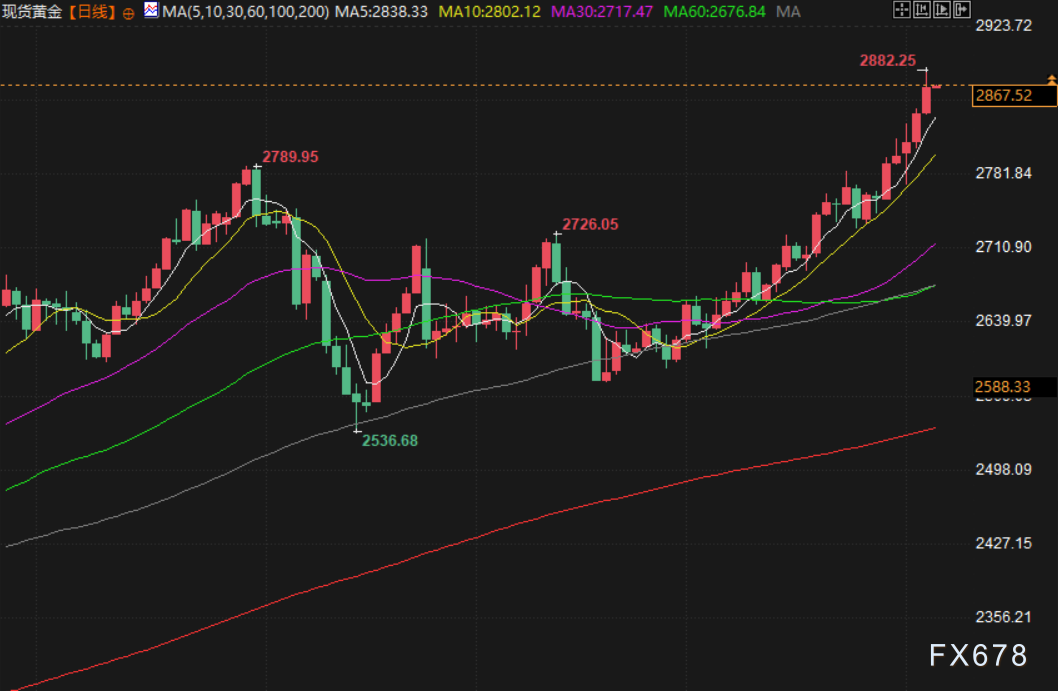
Peter Grant, Vice President and Senior Metals Strategist at Zaner Metals, said, "Gold prices continue to be significantly affected by trade uncertainty, so safe haven fund flows remain the dominant factor
Three Federal Reserve officials have warned that Trump's trade tariffs may drive inflation, with one official stating that the uncertainty in price prospects requires a slower pace of interest rate cuts. The ADP National Employment Report shows that the United States added 183000 private sector jobs last month, while economists expect an increase of 150000.
Investors are looking forward to Friday's US employment report providing further clues about the outlook for interest rates. Non yielding gold is considered an inflation hedge tool, but rising interest rates may weaken its appeal.
Spot silver rose 0.8% to $32.36 per ounce; Platinum rose 1.8% to $980.95; Palladium rose 0.3% to $990.75.
Oil market
Oil prices fell more than 2% on Wednesday due to a significant increase in US crude oil and gasoline inventories, indicating weak demand, while tariff concerns intensified concerns about slowing economic growth. Brent crude oil futures closed down 2.09% to $74.61 per barrel. US crude oil fell 2.3% to $71.03.
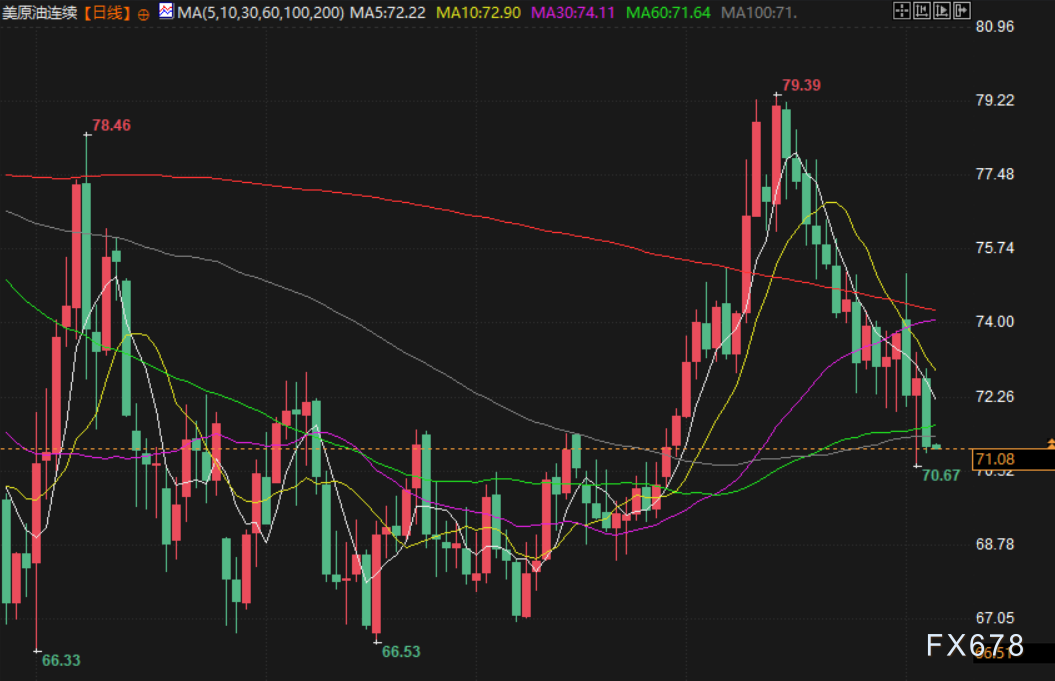
The US Energy Information Administration announced on Wednesday that US crude oil inventories rose significantly last week as refineries facing weak gasoline demand entered a maintenance period.
John Kilduff, a partner at Again Capital, said, "Refineries currently have no demand for crude oil." He added, "Given the weak gasoline demand we have seen, they are all busy with maintenance." Concerns about new trade between the United States and the world's largest energy importing country have also put pressure on prices.
On Wednesday, Iranian President Pezehezhian called on OPEC member countries to unite and confront potential US sanctions, following Trump's statement that he will resume the "maximum pressure" campaign against Iran during his first term.
currencies
The US dollar fell to its lowest level in over a week on Wednesday, easing investors' concerns about trade, while the Japanese yen surged due to strong salary data. The US dollar index fell 0.435% in late trading to 107.58, hitting its lowest level of 107.29 since January 27th earlier.
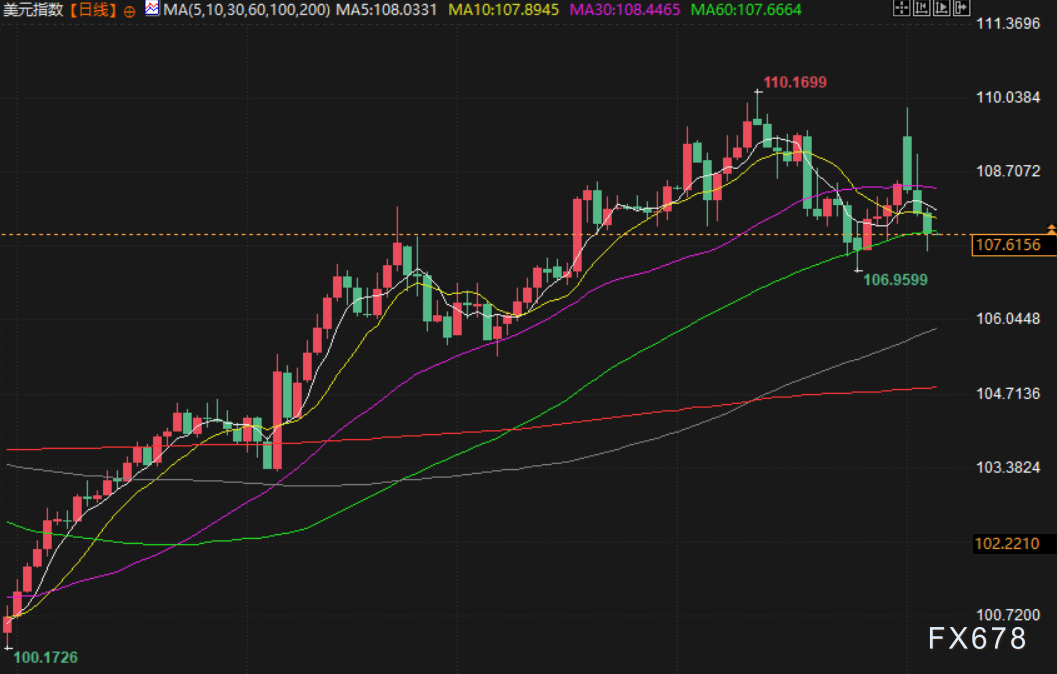
As US President Trump appears to be preparing to impose a 25% import tariff on Mexico and Canada, the US dollar jumped 1.3% on Monday, hitting 109.88. After the two countries won a one month suspension by strengthening border security, the US dollar fell by about 2%.
The euro rose 0.24% against the US dollar to $1.041, but fell 2.3% on Monday due to concerns about the global impact of tariffs and the possibility of taxation expanding to the European Union. The US dollar fell the most against the Japanese yen on Wednesday, boosted by strong salary data in Japan and hints from Bank of Japan officials that further interest rate hikes will be implemented. The US dollar fell 1.19% against the Japanese yen at the end of trading in New York, hitting its lowest level since December at 152.525 yen.
Nick Rees, Head of Macro Research at Monex Europe, said: "The US dollar correction on Wednesday morning appears to be a continuation of recent trends, as the market continues to exclude tariff risks from the foreign exchange market." Data shows that as demand cools down, US service industry activity unexpectedly slowed in January, and the US dollar continued to decline against the Japanese yen.
The Institute for Supply Management (ISM) announced on Wednesday that its non manufacturing Purchasing Managers' Index (PMI) for January fell from 54.0 in December to 52.8, and economists surveyed by Reuters had previously expected it to rise to 54.3. According to other data, due to the increase in winter bonuses, Japan's inflation adjusted real wages increased by 0.6% year-on-year in December. This has led traders to increase their bets on the Bank of Japan raising interest rates this year, believing that the rate hike will be slightly more than 30 basis points before the end of the year. The pound rose 0.2% against the US dollar, hitting a month high of $1.255 earlier.
international news
Trump imposes tariffs on UK and Canada seeking to improve trade relations
The leaders of the UK and Canada had a phone call on Wednesday to discuss improving trade relations, but did not publicly commit to restarting bilateral free trade negotiations that were put on hold last year. The negotiations for the Canada UK Free Trade Agreement were suspended in January 2024, mainly due to agricultural related disputes. According to a statement released by the UK Prime Minister's Office, Prime Minister Stamer welcomed international dialogue on the importance of trade and cooperation between allies and partners during Wednesday's conversation.
The French National Assembly did not pass a motion of no confidence against the government
On the afternoon of February 5th local time, the French National Assembly held two vote of no confidence motions against the current government proposed by the far left political party "Unyielding France", but both motions were not passed. On February 3rd, French Prime Minister Beru announced in the National Assembly that the government had used relevant constitutional provisions to authorize the forced passage of the first part of the 2025 national budget draft and social security budget draft without a vote in the National Assembly. The far left political party "Unyielding France" immediately proposed a vote of no confidence in the government in the National Assembly.
It is reported that the United States will announce a peace plan for Ukraine next week or propose to freeze the current front line
According to insiders, US allies expect the Trump administration to announce the long-awaited plan aimed at ending the Russia-Ukraine conflict at the Munich security conference in Germany next week. Keith Kellogg, Trump's special envoy for Russia Ukraine affairs, will release this blueprint to allies. They refused to disclose the level of detail and format of the discussion. The proposal will be put forward at the meeting held in Bavaria from February 14 to 16, when the Russia-Ukraine conflict is about to enter its third year. Kellogg and others have hinted in recent weeks at what Trump allies call 'seeking peace through strength'. The content includes the possibility of freezing the conflict, leaving the territories occupied by the Russian military in a pending state, while providing security guarantees to Ukraine to ensure that Moscow cannot launch another attack.
Bank of England Treasury Gold Discounted Sale Due to Relatively Delayed Delivery
According to reports, gold in the Bank of England vault is trading at a level lower than the market average price. The reason is that the market is concerned that Trump may impose tariffs, which has triggered a rush to buy gold and resulted in long queues for extracting the bank's gold for weeks. According to insiders, traders are quoting more than $5 per ounce lower than London spot gold prices for Bank of England gold. This price difference is extremely unusual. Normally, the gold trading price of the Bank of England is consistent with other markets in London. In other parts of London, vaults operated by institutions such as JPMorgan Chase and HSBC Holdings are only a few minutes' drive away, and gold trading is frequent. Traders said that in the past, the premium or discount per ounce of gold usually did not exceed a few tens of cents due to the influence of central bank trading activities. The phenomenon of price disconnect is due to global traders competing to ship gold to the United States before possible tariffs are imposed in order to gain a premium. However, due to traders racing against time, the staff of the Bank of England find it difficult to cope with the increasing queue for extracting gold, making the gold in the bank's vault less attractive compared to other commercial vaults in London that offer more convenient access.
Canadian Resources Minister says tariff threat will force Canada to reconsider cross-border oil pipeline projects
The Canadian Minister of Natural Resources stated that US President Trump's trade policies will force Canada to reconsider stalled cross-border oil pipeline projects aimed at transporting the country's crude oil to global markets outside the United States. I think we will have a dialogue in Canada on how to reduce our own vulnerability, "Jonathan Wilkinson said in an interview.
The US Treasury Department will issue its first benchmark 6-cycle Treasury bond on February 18th
The US Treasury Department plans to issue its first benchmark 6-cycle Treasury bill on February 18th as part of its transition plan for regularly issuing 6-cycle cash management notes. The Ministry of Finance will announce the bidding on February 13th, and the latest benchmark treasury bonds will maintain Thursday settlement and maturity cycles. The US Treasury Department also pointed out that before the debt ceiling is suspended or raised, the constraint of the debt ceiling will lead to abnormal fluctuations in the issuance of benchmark Treasury bonds and the extensive use of cash management notes.
Domestic news
Hot travel during the Spring Festival holiday: Multiple data from railway and civil aviation hit new highs, with international flights increasing by over 24% year-on-year
On February 5th, according to the Civil Aviation Administration of China, during the Spring Festival holiday (January 28th to February 4th) in 2025, the operation of civil aviation in China will be safe, stable, and orderly, with a total of 18.24 million passengers transported and an average of 2.28 million passengers per day, an increase of 2.9% compared to the same period of the 2024 Spring Festival travel rush (February 9th to 16th, 2024). Among them, on February 3rd (the sixth day of the Lunar New Year), the national civil aviation sent 2.48 million passengers, setting a new historical high. During the Spring Festival holiday, the national civil aviation has guaranteed a total of 145000 flights, with an average of 18083 flights per day. The normal flight rate has reached 96%, an increase of 3.4 percentage points compared to the same period of the 2024 Spring Festival travel rush. According to data from the Civil Aviation Administration of China, during the Spring Festival holiday, an average of 1888 international passenger flights are guaranteed daily, an increase of 24.6% compared to the same period of the 2024 Spring Festival travel rush, and returning to 86.6% of the average daily level in 2019. Popular routes are concentrated between neighboring tourist destinations such as Japan, South Korea, and Southeast Asia, with the largest number of flights between Japan, Thailand, South Korea, Malaysia, Singapore, Vietnam, and other countries.