**********Macroeconomic factors andecbPolicy uncertainty leads toeuroThe trend is under pressure. Analysts say that the euro will be affected in the futureFederal ReservePolicy direction, European energy crisis, and geopolitical impact. Investment banks generally expect that if the euro cannot break through the technical key level, it may further fall below $1.02. However, the market is still paying attention to potential opportunities for recovery, and short-term trading needs to be cautious of risks.
Federal Reserve Policy
The recent strength of the US dollar is due to the hawkish attitude of the Federal Reserve towards high inflation. Strategists at Citibank believe that the US dollar continues to benefit from its interest rate advantage, and market expectations suggest that the Federal Reserve may maintain high interest rates until the end of 2025, which limits the upward potential of the euro.
European energy crisis
The winter energy supply issue remains a potential risk for the euro. JPMorgan Chase pointed out that despite abundant natural gas reserves in Europe, high energy prices still pose a drag on the Eurozone economy, especially in industrialized countries such as Germany where growth is weak.
geopolitics
Analysts generally believe that the Russia-Ukraine conflict and its impact on the European economy is one of the key factors for the decline of the euro. Dutch International Group stated that the long-term geopolitical risks faced by the eurozone will still affect investor confidence.
Investment bank perspective: Where will the future trend go?
Goldman Sachs analysts believe that if the European Central Bank clearly expresses its determination to continue cutting interest rates, the euro may experience a short-term rebound, but overall it still needs to wait for signals of economic recovery.
UBS predicts that if the Federal Reserve turns dovish in the first half of 2025, the euro/dollar is expected to touch 1.10.
Deutsche Bank holds a more cautious view, believing that the euro may continue to fluctuate between 1.01 and 1.05 in the first half of 2025.
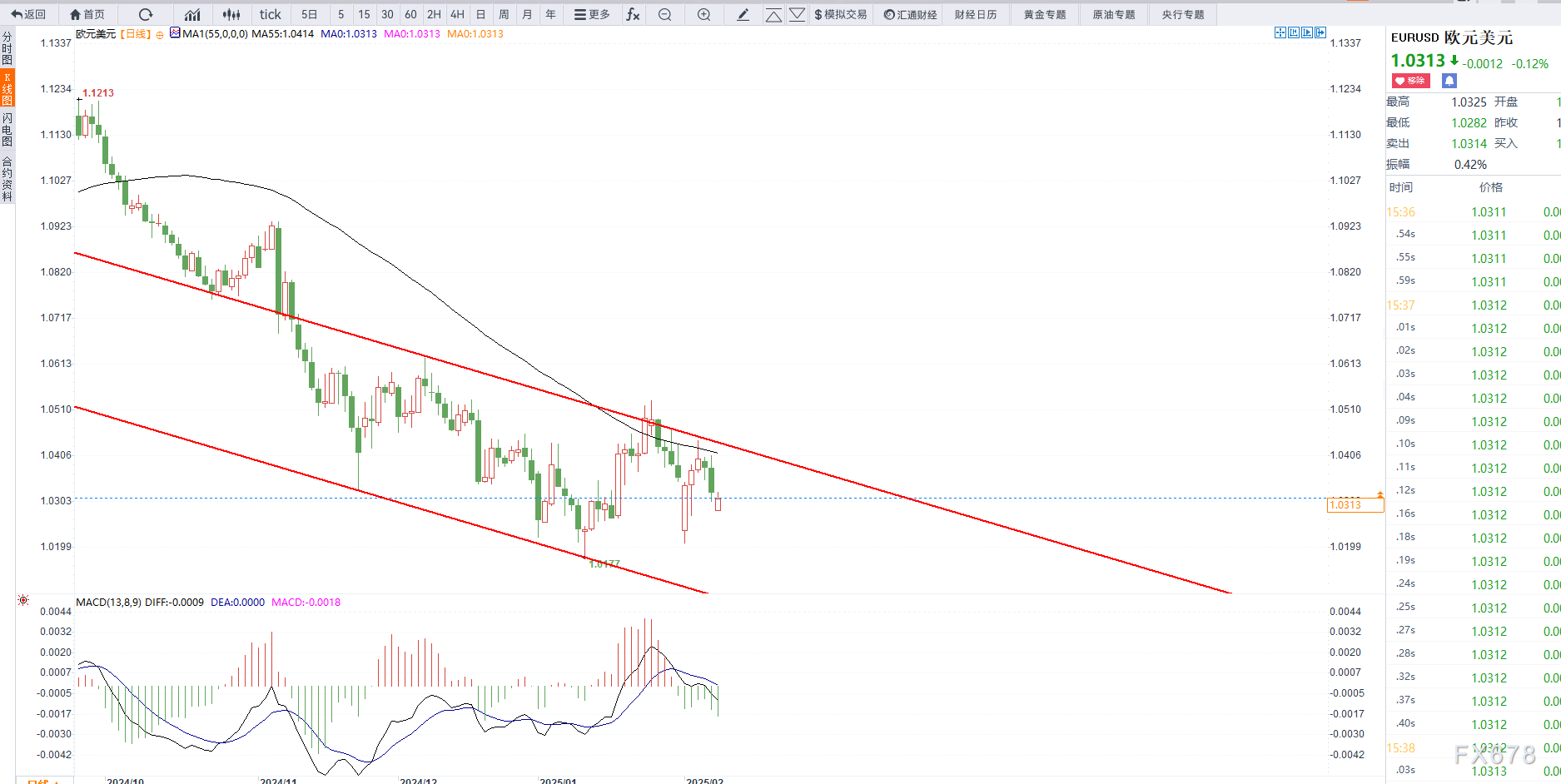
technical analysisThe downward trend is clear. From the technical chart, the euro/dollar is currently constrained by the upper track of the downward channel, and the 55 day moving average of 1.0414 has formed significant pressure. Recent attempts to break through have been unsuccessful. At the same time, the MACD indicator is below the zero axis, and the momentum column tends to contract, indicating that bears still dominate. Technical analysts believe that if the euro falls below $1.03, it may test the bottom of the channel at $1.02.
In addition, the red line channel shows that the overall downward trend has not changed, and the market may continue to show a fluctuating downward trend. Unless the euro breaks through $1.05, the technical structure is difficult to reverse.
Editor's viewpoint:
Combining technical analysis and fundamentals, the probability of a short-term rebound in the euro is low, and investors should focus on the European Central Bank's February interest rate meeting and the Federal Reserve's policy signals. At the same time, traders need to closely monitor technical key positions to prevent the drastic fluctuations that may occur after breaking through.
In summary, the fate of the euro depends on the interweaving of multiple variables. Short term volatility intensifies, investors should remain cautious and set reasonable stop loss and take profit.