**********Adrian Orr, the Governor of the Reserve Bank of New Zealand, stated that compared to the forecast in November last year, RBNZ expects the terminal interest rate to be lower and plans to cut interest rates by another 25 basis points in April and May respectively, provided that the economic situation develops as expected.
If the economic situation continues to develop as expected, the committee has room to further lower the official cash rate (OCR) in 2025, "the New Zealand central bank said in a policy statement.
Reserve Bank of New Zealand Governor Adrian Orr further added at a press conference, "We are lowering the official cash rate faster than predicted in November... We expect OCR to drop to around 3% by the end of this year

The latest forecast shows that New Zealand's official cash rate will drop to 3.45% in June and 3.10% in the fourth quarter, lower than the previously estimated 3.2%. This is mainly due to the inflation rate gradually approaching the midpoint of the central bank's target range of 1% -3%.
Market reaction: The New Zealand dollar briefly fell
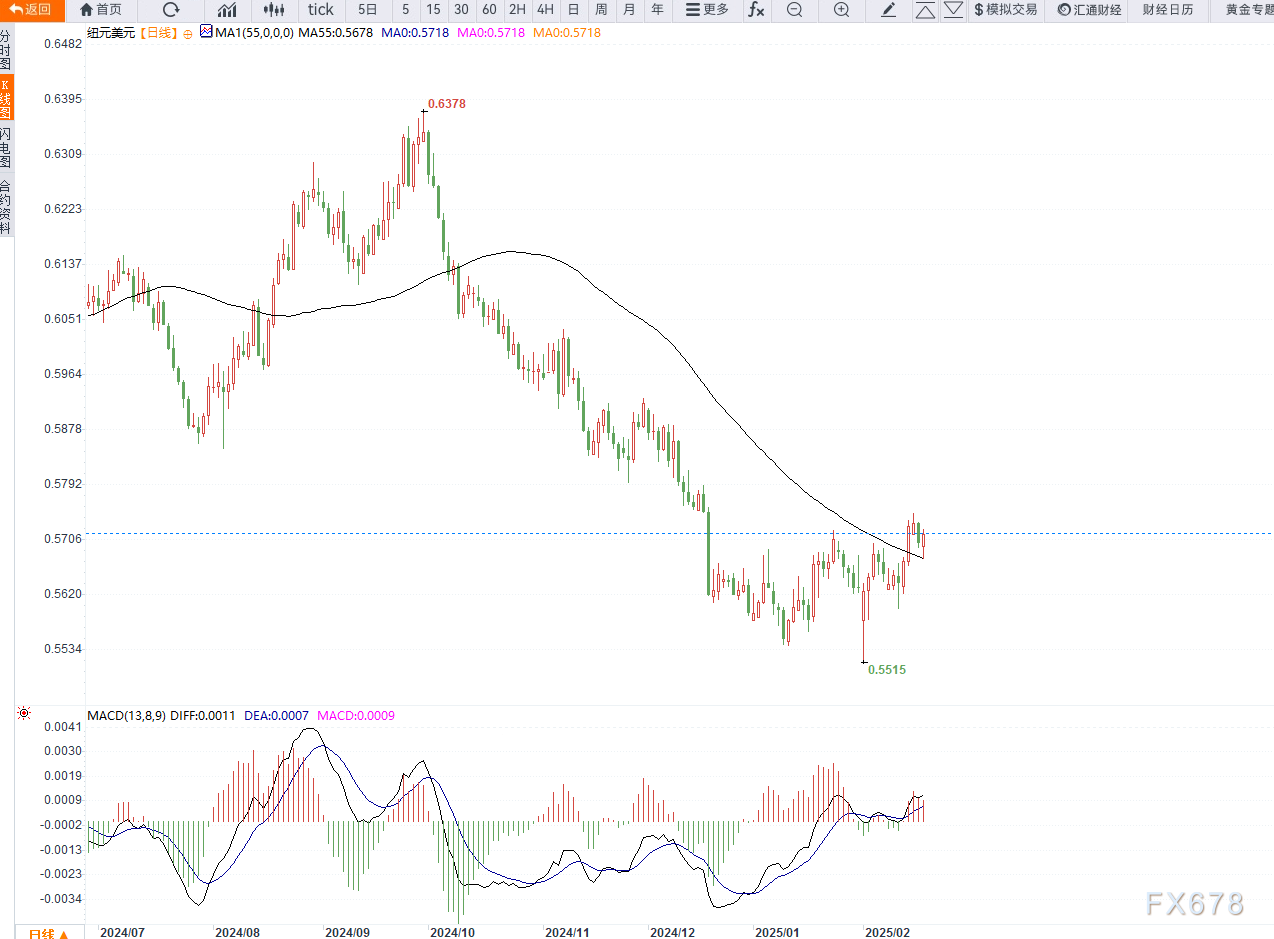
Affected by the dovish stance of RBNZ, the New Zealand dollar fell by 0.3% to 0.5680 against the US dollar at one point, but later rebounded to 0.5707. At the same time, 90 day bank bill futures have risen sharply, and the market has basically digested the expectation of further interest rate cuts in April. It is expected that the year-end interest rate will approach 3%, which is seen as the bottom of this loose cycle.
In addition, major New Zealand banks Westpac, ASB Bank, Kiwibank, and Bank of New Zealand have lowered mortgage rates in response to central bank policies.
Kiwibank Chief Economist Jarrod Kerr commented, "The core message of today's monetary policy statement is a further reduction in the official cash rate path. The Reserve Bank of New Zealand is sending signals of faster and greater rate cuts
Economic Background: From High Inflation to Economic Recession
The Reserve Bank of New Zealand has raised interest rates by 525 basis points since October 2021, marking the most aggressive tightening cycle since the introduction of the official cash rate system in 1999. However, high borrowing costs severely suppressed demand, causing the New Zealand economy to enter a recession in the third quarter of 2023, becoming the most severe economic downturn since 1991.
The economic difficulties have forced the government to adopt a more relaxed fiscal policy. The New Zealand government has abandoned plans to restore fiscal surplus in the short term and expects to continue running a deficit for the next five years.
At present, New Zealand's annual inflation rate has dropped to 2.2%, but the central bank expects it to briefly rebound to 2.7% in the third quarter before falling back again. Despite the easing of inflation, the central bank believes that global uncertainty will still affect economic growth, including the impact of the new US administration's trade policies on global markets.
Junvum Kim, Senior Trader for Saxo Asia Pacific, stated, "The Bank of New Zealand's significant interest rate cut to 3.75% demonstrates its determination to stimulate the economy, even in the face of inflation and global uncertainty risks
Editor's viewpoint:
Overall, the aggressive interest rate cut strategy of the New Zealand central bank has helped boost market confidence in the short term, but the actual effect of the policy still depends on the recovery of domestic demand and the external economic environment. In the future, the market will closely monitor the interest rate decisions in April and May to determine whether the Reserve Bank of New Zealand will further accelerate the pace of interest rate cuts.