**********On Monday, February 3rd, in stock yellowgold priceGe experienced a V-shaped reversal, hitting a intraday low of $2772.06 per ounce before quickly rebounding to a high of $2805.46 per ounce, ultimately trading around $2799.64 per ounce, with a slight decrease of 0.04% for the day. Although the strengthening of the US dollar has put some pressure on gold prices, the safe haven sentiment triggered by US President Trump's tariff remarks still provides support for gold. Last Friday, gold prices briefly hit a historical high of $2817 per ounce, indicating market concerns about global economic uncertainty.

Market background and market overview
At the beginning of this week, the volatility in the gold market intensified, mainly influenced by Trump's tariff rhetoric. Trump announced tariffs on Canada, Mexico, and other countries, and hinted that similar measures may be taken against the European Union. This move has raised concerns in the market about the worsening global trade situation, and investors have turned to safe haven assets such as gold. Although the US dollar index rose sharply during the Asian session, reaching a three week high, gold prices quickly rebounded after a brief decline, indicating a strong demand for safe haven assets in the market.
In addition, the performance of US economic data has also had an impact on gold prices. A series of important data to be released this week, including ISM manufacturing PMI, ADP employment report, and non farm payroll data, may provide more clues to the market about the health of the US economy. These data not only affect the trend of the US dollar, but may also further impact the short-term performance of gold.
Fundamental analysis: Tariff rhetoric and inflation expectations support gold prices
Trump's tariff remarks are undoubtedly the focus of current market attention. He announced over the weekend the imposition of a 25% tariff on Canada and Mexico. This move not only intensified market concerns about the global trade situation, but also triggered an increase in inflation expectations. As a traditional inflation hedge tool, the attractiveness of gold is further enhanced against the backdrop of rising inflation expectations.
At the same time, market concerns about a global economic slowdown are also supporting gold prices. Canada and Mexico have announced retaliatory measures, and the escalation of these trade frictions may put pressure on global economic growth, further driving up market demand for safe haven assets.
From the perspective of domestic economic data in the United States, despite strong consumer spending and inflation data, market expectations for the Federal Reserve's interest rate cuts have not completely dissipated. The Personal Consumption Expenditures (PCE) price index released last Friday showed that the inflation rate in December rose to 2.6% year-on-year, while the core inflation rate remained at a high level of 2.8%. These data indicate that inflationary pressures still exist, which may limit the space for the Federal Reserve to further relax monetary policy. However, Trump's demand for low interest rates and the economic uncertainty that trade frictions may bring still provide potential upward momentum for gold.
Technical analysis: Short term support and resistance levels for gold prices
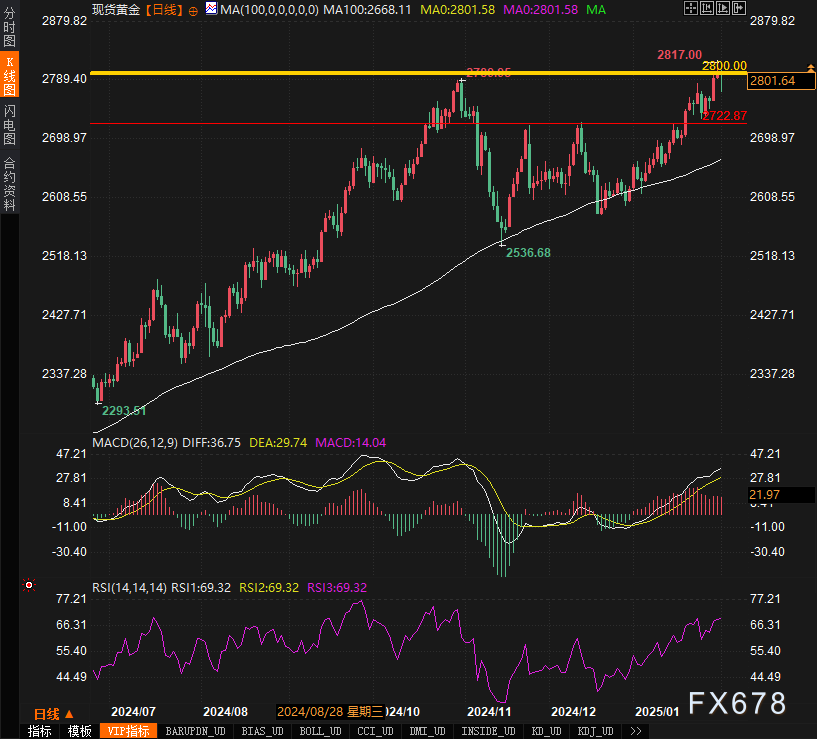
From a technical perspective, the price of gold briefly fell to around $2772 per ounce in early Monday trading, but then quickly rebounded to above $2800 per ounce. This trend indicates that the $2770-2775/ounce range has become a key support level in the short term. If the gold price can hold at this level, it may continue to explore the resistance zone of $2800-2810 per ounce in the short term.
On the other hand, if the gold price falls below the support level of $2770 per ounce, it may further explore the support area of $2755 per ounce or even $2740 per ounce. However, considering the strong risk aversion in the current market, the possibility of a significant drop in gold prices is low.
From a long-term trend perspective, the price of gold is still in an upward channel. The historical high of $2817 per ounce set last Friday indicates that the market's bullish sentiment towards gold remains strong. If the gold price can break through the psychological barrier of $2800 per ounce and remain above this level, it may further explore the target level of $2850 per ounce in the future.
Future Trends and Prospects
Looking ahead, the trend of gold prices will mainly depend on the following factors: firstly, whether Trump's tariff remarks are translated into actual actions, and the response of major global economies. If trade frictions escalate further, the safe haven demand for gold may continue to increase. Secondly, the performance of US economic data will also have a significant impact on gold prices. If the data shows a slowdown in the US economy or rising inflationary pressures, gold may benefit further.
In the short term, the price of gold may fluctuate within the range of $2770-2810 per ounce, but if it breaks through the resistance level of $2810 per ounce, the price of gold may further reach the target level of $2850 per ounce. On the other hand, if market sentiment improves or the US dollar strengthens significantly, gold may face some downward pressure, but the overall upward trend remains unchanged.
Overall, in the current market environment, the position of gold as a safe haven asset remains stable, and investors need to closely monitor the trade situation and changes in US economic data to seize market opportunities.