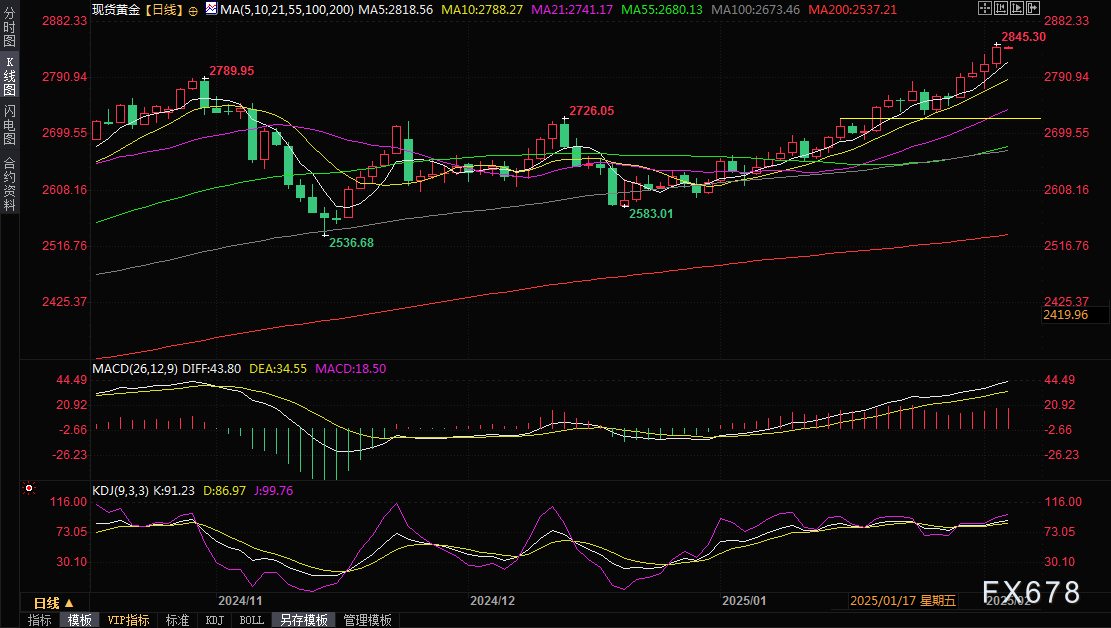
**********On Wednesday (February 5th) morning trading in the Asian market, spot gold fluctuated narrowly near historical highs and is currently trading at around $2841.37 per ounce. The gold price hit a new historical high of $2845.30 per ounce on Tuesday, breaking the record for four consecutive trading days and closing at $2841.85 per ounce, driven by investors seeking safe haven assets. Previously, China targeted the US PresidenttrumpThe tariff measures have taken retaliatory measures. In addition, the largest decline in job vacancies in 14 months in the United States in December also dragged down the US dollar and US Treasury yields, providing upward momentum for gold prices.

Bob Haberkorn, Senior Market Strategist at RJO Futures, said, "Just like Monday, there was tariff news; now, I think this is the main driving force behind it more than any other thing or data that came out on Tuesday, but I think they will all be overshadowed by tariff news
Haberkorn said, "The US dollar has strengthened this week, but as it falls, this will definitely help with gold prices
The US dollar fell 0.4% on Tuesday, closing at 107.99, as gold is priced in US dollars and the decline in the US dollar supports the rise in gold prices. Due to US President Trump'sTariff threatInterpreted more as a negotiation strategy rather than the ultimate goal, he suspended plans to impose tariffs on Mexico and Canada the day before.
However, the new Trump administration has imposed a 10% tariff on goods imported from China since early Tuesday morning, and analysts say they expect the high sensitivity and volatility of tariff developments to continue.
We are still monitoring the imposition of a 10% tariff on China and China's countermeasures, which will add a certain risk premium to the market, "said Helen Given, a foreign exchange trader at Monex USA. We will see if there will be any further negotiations, as in the case of Mexico and Canada before, the tariff tensions may ease. But now it seems that the trade war with China has begun again
Beijing imposed tariffs on some imported goods from the United States on Tuesday, quickly taking countermeasures against the new round of tariffs imposed by the United States, increasing the risk of a showdown between the world's two largest economies.
Mitsubishi UFJ Financial Senior Currency Analyst Lee Hardman said, "Beijing's actions suggest that China is cautious in its response to Trump's latest tariff measures and has not taken an overly aggressive counterattack, while leaving room for future negotiations
The market is still paying attention to Trump's tariff threat to the European Union.
Goldman Sachs analysts said in a research report: "Although the prospect of imposing broader comprehensive tariffs on the EU is very uncertain (now), as long as the fluctuations in tariffs continue, the long-term trade uncertainty environment itself will put pressure on the euro.
EU trade chief Maros Sefcovic stated on Tuesday that the EU hopes to quickly engage with the US regarding the tariffs planned by US President Trump; Von der Leyen, president of the European Commission, predicted that the negotiations with Washington would be difficult.
European Commission Vice President Sevkovic stated at the EU ministerial meeting that he hopes for "early engagement" and is waiting for Trump's confirmation of the appointments of US Commerce Secretary nominee Howard Lutnick and Trade Representative nominee Jamison Greer.
Sefkovic told reporters, "We are ready to engage immediately and hope that through this early engagement, we can avoid taking measures that would cause a lot of disruption to the world's most important trade and investment relations
Von der Leyen said that the top priority is to deal with areas where the interests of the EU and the United States converge, such as key supply chains and emerging technologies, and said that the EU is ready for difficult negotiations.
In her speech in Brussels, she stated, 'We will approach the methods to achieve this goal with an open and pragmatic attitude. However, we will also make it clear that we will always uphold our own interests.'.
White House trade advisor Peter Navarro said that Europe's confrontation with the United States on the issue of car value-added tax shows the difficulty of negotiations. EU countries levy value-added tax on the sale of all cars domestically and internationally.
EU officials have stated that their contact with the new Trump administration is limited and pointed out that dialogue cannot take place until the senior position candidates selected by Trump are confirmed. Since Trump took office, von der Leyen has not contacted Trump.
Trump has stated that the EU is the next target. He has repeatedly complained about the trade deficit in goods between the United States and the European Union. Navarro believes that this figure is $350 billion.
Sefkovic stated that the trade deficit, including services, is approximately 50 billion euros, or about 3% of the annual trade volume of 1.5 trillion euros between the European Union and the United States, and millions of jobs between Europe and the United States depend on this open trade relationship.
Sefkovic said, "We believe that through constructive engagement and discussion, this issue will be resolved
In terms of economic data, the US job vacancies in December saw the largest decline in 14 months, which also dragged down the US dollar and US Treasury yields, providing upward momentum for gold prices. But stable recruitment and low layoffs suggest that the job market has not suddenly slowed down, and the Federal Reserve may not cut interest rates until at least June.
The Job Openings and Labor Mobility Survey (JOLTS) released by the US Department of Labor on Tuesday showed 1.1 job vacancies per unemployed person, down from 1.15 in November. Federal Reserve Chairman Powell told reporters last week, 'We don't need to rush to adjust our policy stance.'“
Conrad DeQuadros, Senior Economic Advisor at Brean Capital, said, "Federal Reserve officials may interpret this report as implying that the job market has cooled from its previous overheated state, but employment demand remains stable relative to the existing supply of workers
The US Bureau of Labor Statistics stated that as of the last day of December, job vacancies measuring labor demand decreased by 556000 to 7.6 million. This is the largest decline since October 2023.
The number of job vacancies in November has been revised up to 8.156 million, compared to the previous value of 8.098 million. Economists had expected 8 million job vacancies in December. The number of job vacancies has decreased by 1.3 million compared to the previous year, but it is still higher than the average level in 2019.
The job vacancy rate decreased from 4.9% in November to 4.5%. Enterprises with 10 to 49 employees have the largest decrease in job vacancies, followed by those with 50 to 249 employees.
The yield of US treasury bond bonds fell in the volatile trading on Tuesday, and was also dragged down by the continuing uncertainty surrounding the US government's trade policy. Many headlines about tariffs had been emerging before, and finally Canada and Mexico obtained a 30 day tariff suspension.
The yield on 10-year US Treasury bonds fell 2.8 basis points to 4.515% in late Tuesday trading, and on Monday it hit its lowest point since mid December. This rate of return is considered risk-free by the market and is also the opportunity cost of holding gold. A decrease in the rate of return will support the price of gold.
Lawrence Gillum, Chief Fixed Income Strategist at LPL Financial, said, "In the coming quarters, the market will constantly weigh between tariffs and threats - which are practical policies and which are just empty threats, and this tug of war will continue to unfold
I still believe that the 10-year bond yield may fall below 4% later this year, but this is actually based on an economic slowdown, "Gillum said." If the data continues to remain stable, we have no reason not to trade between 4.50% and 5%
Chip Hughey, Managing Director of Fixed Income at Truist Advisory Services, said, "Although the market expects further declines in returns, the lack of policy clarity is making medium - and long-term investors increasingly cautious
At the same time, the US interest rate futures market expects a rate cut of approximately 46 basis points this year, which means almost two rate cuts of 25 basis points each time. According to calculations by the London Stock Exchange Group (LSEG), this number is 41 basis points higher than late Monday, and the first rate cut may occur at the Federal Reserve's policy meeting in June or July.
Investors' focus now shifts to Wednesday's ADP employment report, Friday's employment report, and speeches from multiple Federal Reserve officials.