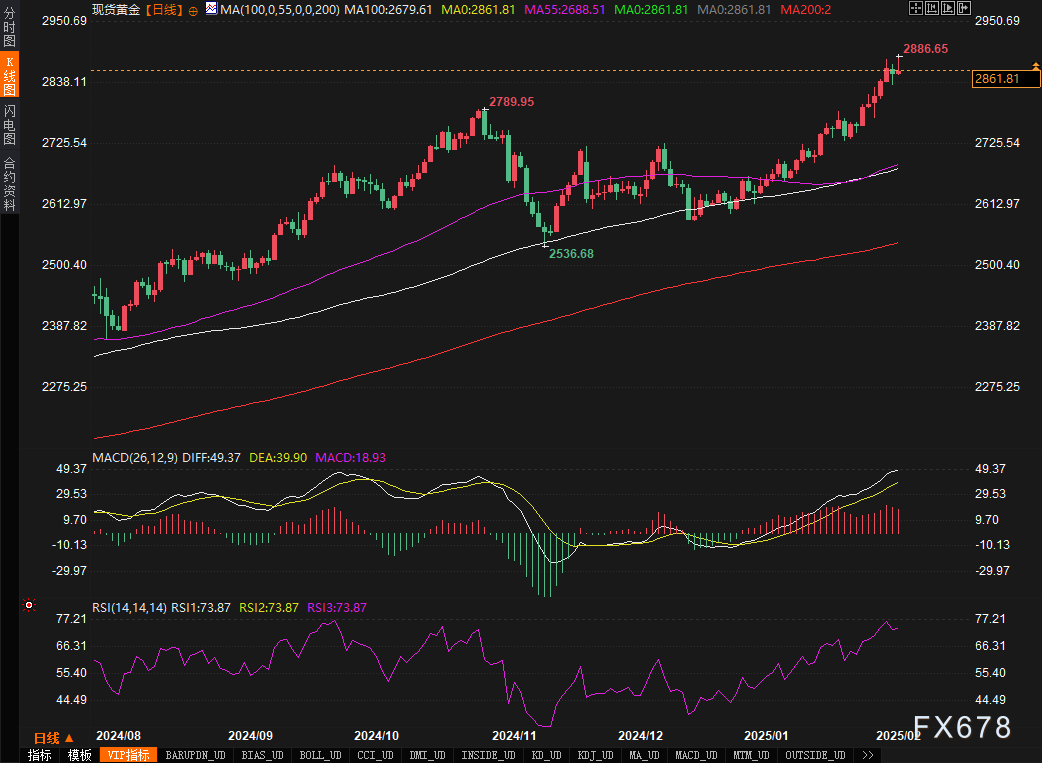
**********This week, the gold market continued its strong upward trend, with prices rising for the sixth consecutive week driven by multiple favorable factors and reaching a historic high of $2886.65 in trading. One of the main driving factors is the surge in safe haven demand, especially against the backdrop of increasing global political and economic uncertainty, as investors flock to the traditional gold marketsafe-haven assets。

Firstly, the tense global political situation and US President Trump's announcement of tariffs on Mexico and Canada have provided strong support for gold prices. Although Trump has temporarily delayed the implementation of tariffs on Mexico and Canada for a month, the high uncertainty in the market has led to strong demand for gold among investors.
In addition, the news that the People's Bank of China continued to increase its gold reserves further supported the gold price. Since July last year, the People's Bank of China has increased its holdings of gold for three consecutive months. In January, it purchased five tons of gold, raising its gold reserves to 2285 tons. Although the proportion of China's gold reserves in its foreign exchange reserves is only 5%, this continuous increase in purchases indicates that China may continue to increase its proportion of gold reserves in the future, which is also an important factor of market concern.
The impact of economic data on the gold market
In addition to geopolitical factors, some economic data this week also had an impact on the gold market. The January non farm payroll data released by the US Department of Labor was slightly lower than expected, with 143000 new jobs added, compared to economists' expectations of 170000. Although the unemployment rate remains at a low level of 4%, the weak employment data suggests that the pace of the US economic recovery may slow down, providing further support for the gold market.
In addition, the core inflation data of the eurozone is slightly higher than expected, with an annualized inflation rate of 2.5% in January, which is mainly affected by the rise in energy prices, although food inflation has fallen slightly. The ISM manufacturing index in the United States also saw a better than expected increase in January, reaching 50.9, indicating the recovery momentum of the US manufacturing industry. However, the decline in the PMI and ISM index of the service industry reflects the imbalance of US economic growth.
Analyst opinions and institutional forecasts
Regarding the future direction of the gold market, many analysts and institutions unanimously believe that gold prices will maintain a strong upward trend in the medium to long term. The rise in gold prices is not only due to recent tariff issues, but the continuous buying of gold by global central banks also provides long-term support for the gold market. According to the World Gold Council (WGC), global central bank gold purchases reached 1045 tons in 2024, significantly exceeding the average annual level of the past decade, indicating that central bank demand for gold remains strong.
Krishan GoPaul, Senior Analyst at the World Gold Council, stated that China's gold reserves continue to increase, reflecting the central bank's preference for gold as a safe haven asset. He pointed out that although China's gold reserves still account for a relatively low proportion of its foreign exchange reserves, it is expected that China may continue to increase its holdings of gold in order to diversify its foreign exchange reserves in the future. In addition, countries such as Poland, Czech Republic, and Uzbekistan are also increasing their gold reserves, further indicating that global gold demand remains strong.
Joseph Cavatoni, The market strategist of the World Gold Council also stated that with the intensification of global geopolitical uncertainty, the demand for gold from central banks may further increase. Especially against the backdrop of increasing government debt burden and changing global political situation, central banks will continue to seek to diversify risks by increasing their holdings of gold. He also emphasized that although gold prices have risen, the central bank's demand for gold purchases will not weaken due to price increases, and it is expected that gold prices will continue to rise in 2025.
Next week's outlook: Key risks and opportunities in the gold market
Looking ahead to next week, the gold market will still be closely influenced by the global economic and political situation. Firstly, the United States will release the Consumer Price Index (CPI) for January, which will be the focus of market attention next week. If CPI data performs strongly, it may increase market expectations for the Federal Reserve to raise interest rates, thereby putting pressure on gold prices. On the contrary, if inflation data is weak, it may further support the rise in gold prices.
In addition, the political situation in Washington remains an important variable in the gold market. The new trend of tariffs by the Trump administration remains an important factor affecting market sentiment. Although Trump has temporarily delayed the tariff measures on Mexico and Canada, it does not mean that the tariff issue has been resolved, and investors need to closely monitor the development of the situation.
Other major economies around the world will also release important economic data. The employment data in the Eurozone will be the highlight next week, while China will release CPI and PPI data, which will affect global market sentiment and subsequently impact gold prices. It is worth noting that as trade uncertainty may lead to continued global market uncertainty, the demand for gold as a safe haven asset is expected to remain at a high level.
summarize
Overall, the gold market has performed strongly this week, reaching a historic high, mainly driven by safe haven demand, weak US non farm payroll data, and continued increases in gold holdings by global central banks. The uncertainty in the market remains the core driving force behind the rise of gold, with geopolitical tensions and weak expectations for the global economy prompting investors to seek asset allocation in safe haven assets such as gold. With the further development of US economic data and global political situation next week, the gold market will face new challenges and opportunities. However, against the backdrop of global central banks continuing to buy gold and the continued demand for safe haven, there is still significant room for gold prices to rise.