**********On Monday (February 10th), US crude oil rebounded slightly during the Asian trading session, trading around $71.40 per barrel. Fundamental trade tensions further pressured global economic growth, leading to a resurgence of mid-term downward expectations for oil prices.
At the same time, after the landing of US non farm payroll data, the market's expectations for the Federal Reserve to cut interest rates further slowed down, while the US dollar index continued to rise. Under the resonance of multiple negative factors in the short term, it is not ruled out that oil prices may accelerate their decline. We will continue to pay attention to whether the trade conflict will further escalate and drive oil prices to break through.

trumpIt is announced this week that reciprocal tariffs will be imposed on many countries
US President Trump announced last Friday (February 7th) that he plans to impose equivalent tariffs on many countries on Monday or Tuesday, which is a major escalation of his trade conflict.
Trump did not specify which countries would be affected, but hinted that this would be a broad measure that could help address the US budget issue.
I will announce a reciprocal trade policy next week so that we are treated equally with other countries, "Trump said. We don't want more, nor do we want less
This move will fulfill Trump's campaign promise to impose tariffs on US imports at the same rate as trading partners impose on US exports. Trump announced this news during his meeting with visiting Japanese Prime Minister Shigeru Ishiba.
He said that car tariffs are still under consideration, despite reports that the White House is weighing possible exemptions. Three sources familiar with the plan told reporters that Trump revealed his plan to Republican lawmakers during budget discussions at the White House on Thursday.
Trump and senior aides have said that they plan to use higher tariffs on foreign imports to help pay for the extension of Trump's tax reduction policy in 2017. Independent budget analysts said that this tax reduction policy may increase the US debt by trillions of dollars.
Raising tariffs can offset some of the costs, although in recent years tariffs have only accounted for about 2% of annual revenue. After media coverage of Trump's discussions with lawmakers, Wall Street widened its decline on Friday.
At last Thursday's confirmation hearing, Trump's nominee for US Trade Representative, Greer, stated that other countries need to reduce barriers to US exports if they want to continue entering the US market, with particular reference to Vietnam.
Greer said, 'If my nomination is confirmed, I need to go to these countries and explain to them that if they want to continue enjoying market access in the United States, we need better reciprocal trade.'.
Three Federal Reserve decision-makers believe that the job market is healthy and are not in a hurry to cut interest rates
Three Federal Reserve decision-makers stated last Friday that the US job market is robust and pointed out the uncertainty of how Trump's policies will affect economic growth and still high inflation, highlighting the rationality of their approach of not rushing to cut interest rates.
Last Friday, the US Department of Labor announced that the January unemployment rate was 4%, with 143000 new jobs created, which is consistent with the situation described by Federal Reserve Governor Cugler.
Kugler said in Miami, Florida, "The labor market is healthy, with neither weakening nor signs of overheating." She also noted that there is still "considerable uncertainty" about the impact of the new policy proposal on the economy, and "recent progress in inflation has been slow and fluctuating, with inflation rates still high.
According to the inflation indicator that the Federal Reserve focuses on, namely the year-on-year increase in the Personal Consumption Expenditures (PCE) price index, the US inflation rate rose at the end of last year, reaching 2.6% in December. The Federal Reserve's target is 2%.
Considering this series of factors, the prudent approach is to maintain the federal funds rate unchanged for a period of time, "said Kugler
Just before Kugler's speech, a survey released by the University of Michigan showed that consumers' expectations for inflation in the coming year had risen by a full percentage point, reaching 4.3%, the highest since November 2023.
Minneapolis Federal Reserve Chairman Kashkari said last Friday that policy uncertainty has put the Fed in a "wait-and-see" mode. "
We are currently in a favorable position and can maintain our current level until we have more information on tariffs, immigration, taxation, and other related matters.
Kashkari said that the inflation data for the next two months is crucial for the Federal Reserve's policy-making. If we see very good inflation data while the labor market remains strong, then I believe this will make me inclined to support further policy easing.
Chicago Fed President Goolsby said he is not too concerned about households expressing new concerns about inflation, citing that inflation expectations in financial markets are firmly anchored.
Although he also pointed out that policy uncertainty means the Fed should act slowly, he said on Friday that he believes the Fed's policy rate will "significantly" decrease within 12-18 months. "
I believe that in terms of inflation, we are on the path to returning to 2%, "Gulsby said." As the inflation rate decreases, we can correspondingly lower interest rates.
From a technical perspective, the daily US crude oil price has fallen below the support of the 55 day moving average, while the MACD is accelerating its decline. There is no sign of a short-term stop to the decline, and we are waiting for a pullback around $72 to confirm if the pressure is effective. If it falls below the $70 integer mark, we cannot rule out the possibility of an accelerated decline in oil prices.
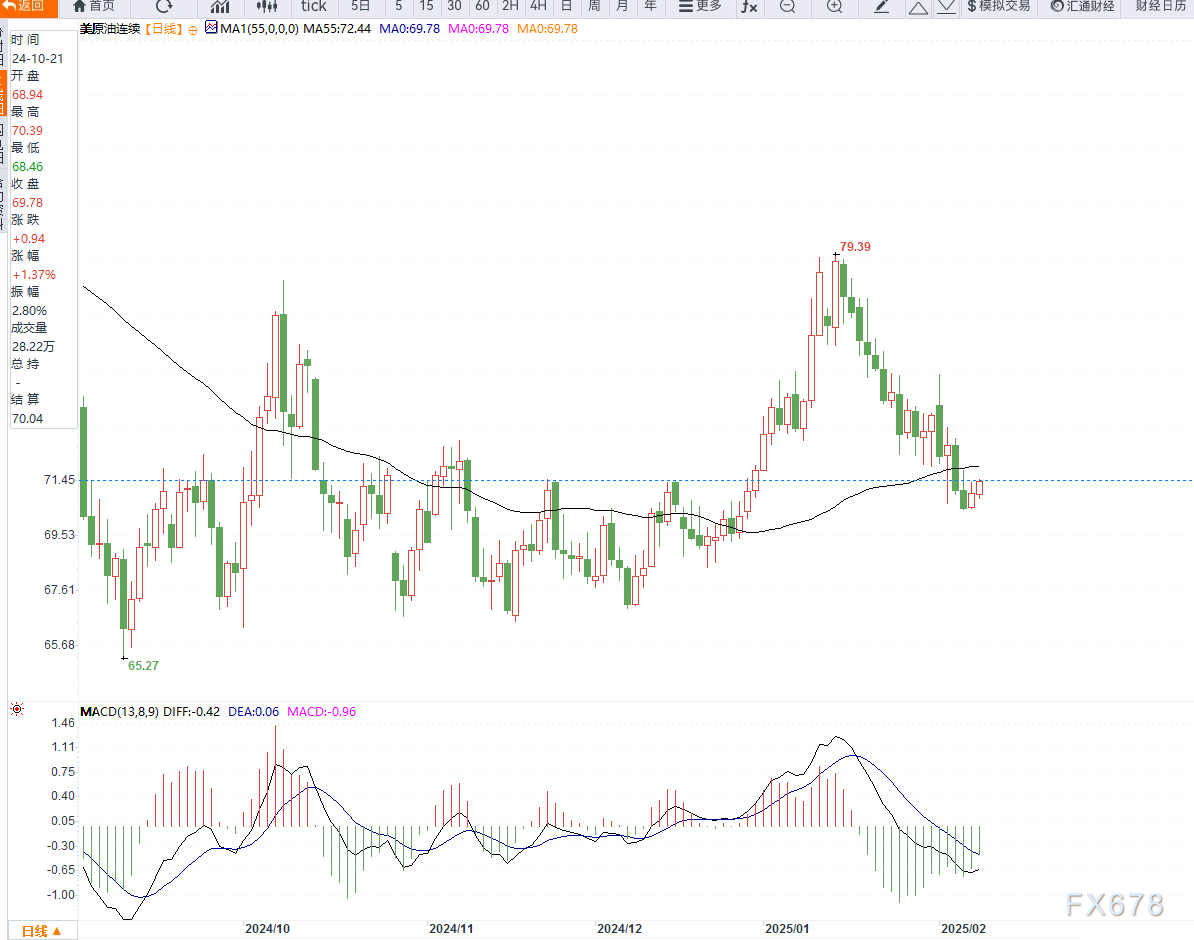
At 10:08 Beijing time, US crude oil is currently reported at $71.50 per barrel.