**********On Tuesday (January 21), the US crude oil continued to decline during the Asian trading session, trading around $76.75 per barrel, on a fundamental level similar to that of the US PresidenttrumpPressure on policy uncertainty upon taking officeoil price。
Although the United States launched a new round of sanctions against Russia, the new president said that the Russia-Ukraine conflict should be ended as soon as possible, which eased the tension in the geopolitical situation. Therefore, after the previous sharp rise, the oil price remained within the range of shock and decline in the medium term.
Pay attention to whether the supply-demand balance has been broken again, thereby putting pressure on oil prices. Pay attention to changes in inventory data in the short term. This trading day, pay attention to API inventory data. At the same time, the US crude oil contract is changing months recently to guard against significant fluctuations.

A Trump administration official did not provide details about the national emergency in a speech earlier on Monday, but Trump and his allies have hinted that they will use their power to quickly approve new oil, gas, and power projects that typically take years to get approved.
The official said that Trump will also sign an executive order targeting Alaska, and added that the state is crucial to US national security and can export liquefied natural gas to other regions and allies in the United States.
Trump also stated in his inauguration speech that he would impose tariffs on other countries and promised to thoroughly reform the trading system. UBS analyst Giovanni Staunovo said the focus is on which executive orders Trump will sign in the next 24 hours.
It is expected that Trump will also announce some policies, including ending the ban on issuing liquefied natural gas export licenses, as part of a broader strategy to strengthen the economy.
Analysts from ANZ Bank stated in a client report that while new sanctions may reduce Russia's oil supply by nearly 1 million barrels per day, the recent price increase may be short-lived depending on Trump's actions.
They said that Trump has promised to help quickly end the Russia-Ukraine conflict, which may involve relaxing some restrictions in order to reach an agreement. Analyst Tim Evans stated that the new sanctions are expected to reduce supply at least in the short term.
He pointed out at Evans on Energy that "the increase in tanker rates without loaded vessels and the widening of the inverse price difference of crude oil across months are obvious chain reactions that exacerbate people's concerns about supply.
Trump, who is about to take office, is preparing to sign about 200 executive orders to reignite his agenda. In the energy sector, he plans to declare a 'national energy emergency' to accelerate domestic crude oil and natural gas production and reduce energy costs for American households.
According to reports, Trump will overturn the Biden administration's de growth climate regulations and develop new oil and gas projects on federal land. These measures aim to promote a comprehensive recovery of the US energy industry from oil fields to car dealerships.
A soon to be White House energy advisor stated that these executive orders will create conditions that promote investment, job creation, and the development of America's natural resources. Trump plans to increase the power supply capacity of the national power grid through emergency orders to cope with the surge in electricity demand caused by the launch of artificial intelligence data centers.
Overall, after the new US President Trump took office, the market's expectations of policy uncertainty have further strengthened, which is not conducive to the rise of oil prices. Although it has not fallen below the range support in the short term, the volatility has further increased, and the direction of waiting for market sentiment to recover after policies are implemented is the main choice.
On a technical level, US crude oil is still within the bullish range. Currently, the retracement has driven the moving average upward and corrected the deviation value. If it does not fall below the central axis support of $75 in the short term, it is expected to continue to rebound, waiting for stabilization as the main factor, and observing whether the support position is effective.
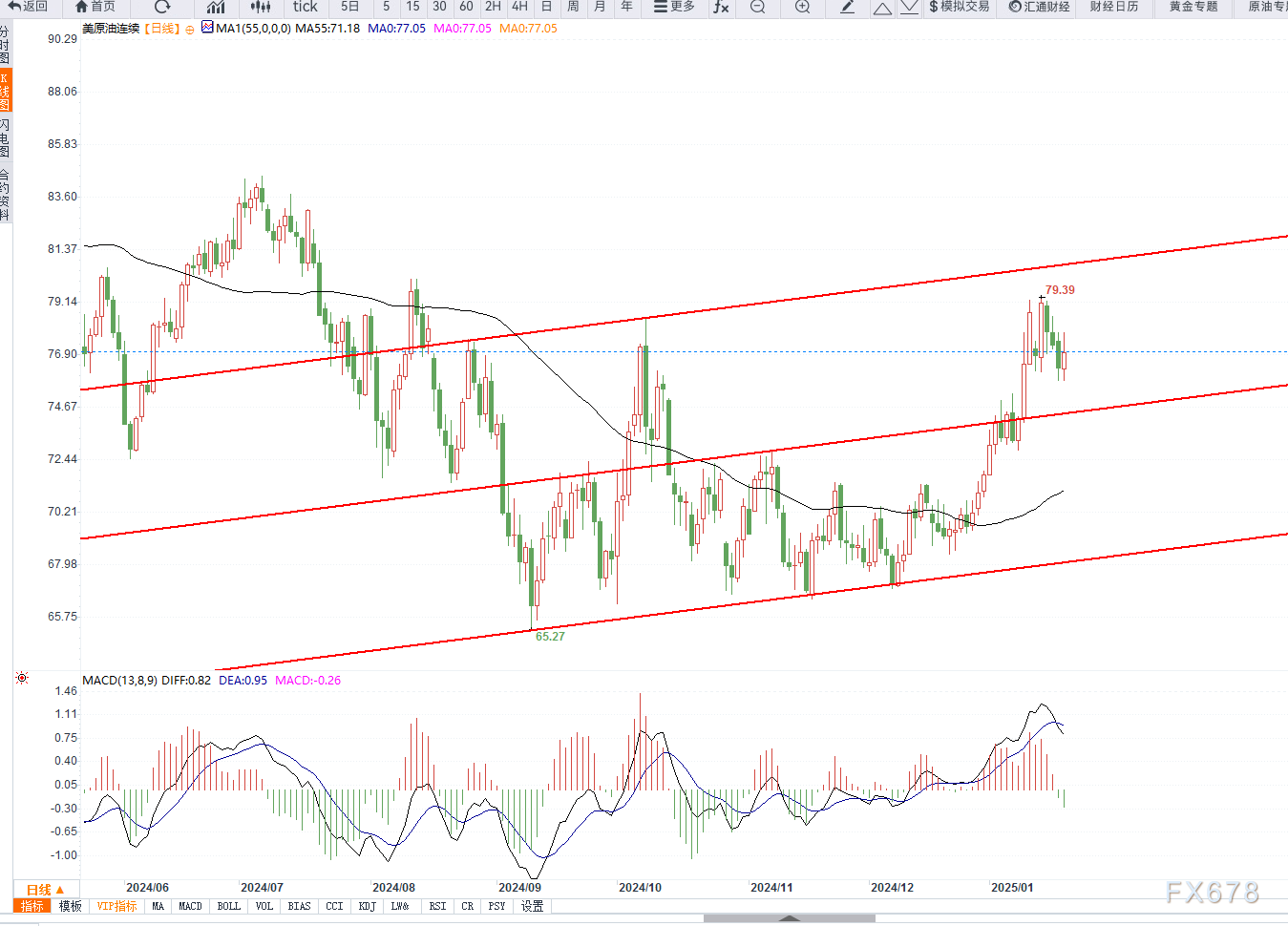
At 10:14 Beijing time, US crude oil is currently reported at $77.04 per barrel.