**********On Thursday (February 6th), US crude oil rose slightly during the Asian trading session, trading around $71.20 per barrel, mainly due to a significant increase in US crude oil and gasoline inventories,Concerns about demandEmotions resurface.
Meanwhile, concerns over trade conflicts have intensified worries about a slowdown in global economic growth. Under the dual pressure of supply and demand in the short term, it is difficult for oil prices to rebound, and the possibility of falling below the intensive support range cannot be ruled out.
Before the bearish sentiment is fully released, a volatile downward trend is a high probability event, waiting for further changes in fundamentals.

According to the weekly report of the US Energy Information Administration (EIA), the EIA in the United States last weekoil inventoryAn increase of 8.66 million barrels is expected, with the market expecting an increase of 3.4 million barrels and analysts expecting an increase of 1.03367 million barrels, compared to an increase of 3.463 million barrels in the previous week.
The increase in EIA crude oil inventories in the United States for the week ending January 31 was the largest since the week ending February 9, 2024. The increase in domestic crude oil production for the week ending January 31 was the largest since the week ending November 22, 2024, ending the previous seven week downward trend.
The short-term inventory surge is unfavorable for the bullish rebound of oil prices, and the bearish trend is accelerating downward.
John Kilduff, a partner at Again Capital, said, "Refineries currently have no demand for crude oil." He added, "Given the weak gasoline demand we have seen, they are all busy with maintenance
At the same time, the uncertainty of the geopolitical situation is weakening its support for oil prices. On Wednesday, Iranian President Pezehezhian called on OPEC member countries to unite and resist potential sanctions imposed by the United States.
Previously, Trump stated that he would resume the "maximum pressure" action he implemented against Iran during his first term, but oil prices have shown average performance and currently bears still dominate.
The probability of the Federal Reserve cutting interest rates in March is 16.5%, and the probability of a rate cut in May is 40.8%
According to CME's "Federal Reserve Watch", the probability of the Federal Reserve keeping interest rates unchanged in March is 83.5%, and the probability of cutting interest rates by 25 basis points is 16.5%.
The probability of maintaining the current interest rate unchanged until May is 59.2%, the probability of reducing interest rates by 25 basis points cumulatively is 36.0%, and the probability of reducing interest rates by 50 basis points cumulatively is 4.8%.
The slowdown in expectations of interest rate cuts by the Federal Reserve has once again put pressure on expectations of economic stimulus, putting continued pressure on demand expectations and hindering a bullish rebound in oil prices.
From a technical perspective, the daily US crude oil price has fallen below the support range and continues to decline after confirming the pressure of the pullback. The 55 day moving average has fallen below the combined MACD indicator, accelerating the downward trend, which is unfavorable for the short-term rebound of oil prices.
Focus on whether the integer level of US $70 will accelerate to break, and focus on US non farm data this week.
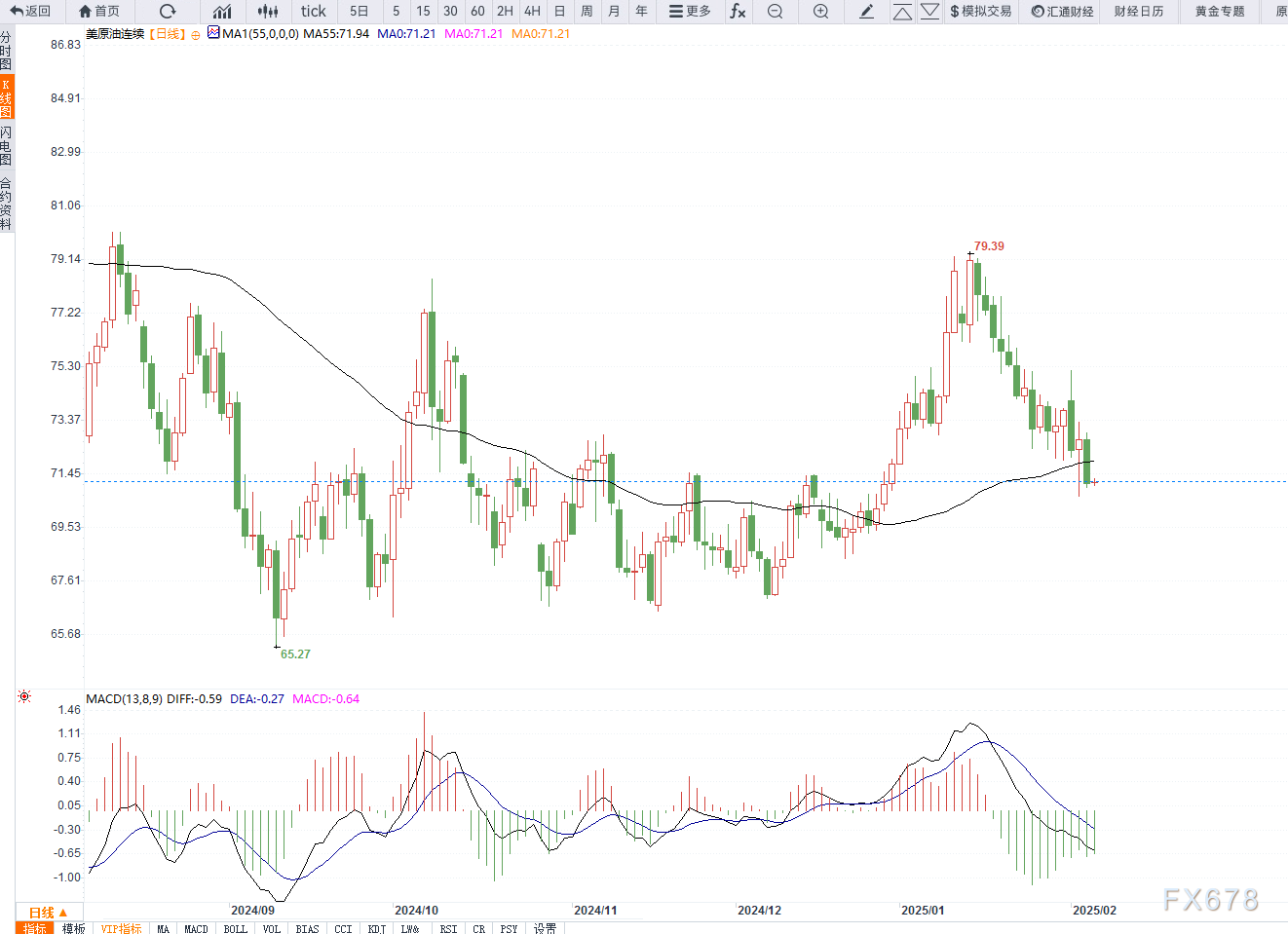
At 09:47 Beijing time, US crude oil is currently reported at $71.21 per barrel.